
Reviewed · TANGIER TOURS
10D Morocco Tour From Tangier By Imperial Cities And South Desert
Morocco packs a lot into ten days. This private route links Tangier, Chefchaouen, Fes, the Sahara, Ait Ben Haddou, and Marrakech, giving you a broad look at the country without asking you to manage trains, taxis, hotels, and desert transfers yourself. I especially like the private door-to-door transport and the chance to sleep in a desert camp with a private tent, toilet, and shower. The main drawback is the pace: several days involve long drives, and you will need energy for early starts and walking on uneven medina streets.
I also like the balance between famous sights and smaller cultural stops, from Barbary monkeys near Azrou to drumming in Khemliya and fossil workshops in Erfoud. The tour is priced at $1,439.99 per person, which is a strong package value for nine nights of lodging, transport, guides, breakfasts, and the Sahara stay, but you should budget extra for six dinners, lunches, entry fees, drinks, and tips.
In This Review
- Key Things to Know Before Booking
- Tangier Arrival and the Far Northwest
- Chefchaouen and the Blue Streets of the Rif
- Volubilis, Meknes, and Arrival in Fes
- Fes Medina: Souks, Tannery, and Tilework
- Across the Middle Atlas to Erg Chebbi
- Sunrise, Khemliya, and the Dades Valley
- Ouarzazate, Ait Ben Haddou, and the High Atlas
- Marrakech’s Medina and Major Monuments
- What the $1,439.99 Price Really Covers
- Who Should Book This Morocco Route
- Final Verdict: A Strong Choice for a First Morocco Visit
- FAQ
- Where does the tour begin and end?
- Is this a private tour?
- How many nights of accommodation are included?
- Is the Sahara camp included?
- Which meals are included?
- Can the tour be canceled for a full refund?
Key Things to Know Before Booking
- A true north-to-south route: Begin in Tangier and finish at Marrakech Menara Airport, with the country’s main imperial cities and desert region in between.
- A private trip for your group: You are not traveling with strangers, and the schedule can be modified to fit your dates.
- The Sahara is the centerpiece: Ride a camel to Erg Chebbi, watch sunset and sunrise over the dunes, and spend the night in a private luxury camp.
- Fes gets proper time: A half-day guided visit covers the medina, Chouara Tannery, religious schools, souks, and the Mellah.
- Long driving days are part of the deal: Fes to Merzouga and the route from Dades to Marrakech cover major distances, but they also reveal Morocco’s changing scenery.
- Good support from the tour team: Feedback often singles out drivers and guides such as Said, Tariq, Khalil, and Med for clear communication, warm service, and careful scheduling.
Tangier Arrival and the Far Northwest
Your Moroccan trip begins with a pickup at Tangier airport or port. A driver-guide meets you outside the terminal with a sign bearing your name, then takes you to your hotel. This is especially helpful if you arrive late or come by ferry and do not want to negotiate a taxi after collecting your bags.
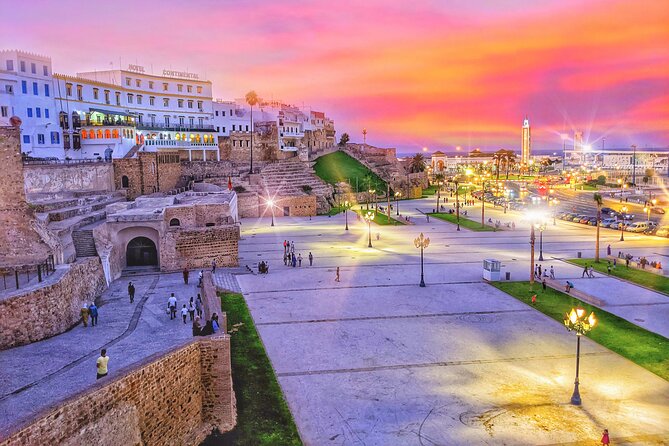
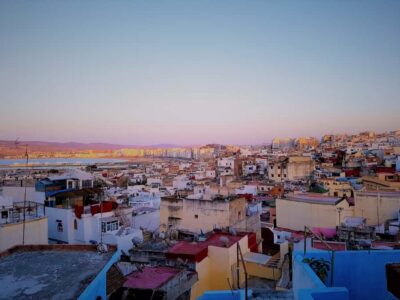
If you arrive with time to spare, head into Tangier’s medina. The old quarter is a maze of homes, shops, and narrow lanes, with the remains of a 15th-century Portuguese fortress adding a strong reminder of the city’s position at the meeting point of Africa and Europe. Zoco Chico square is a useful place to stop for food and people-watching.
The seafront corniche is another easy first-day outing. A late afternoon walk gives you a chance to get your bearings without committing to a major sightseeing plan. That matters after a flight or ferry crossing.
Day two starts with more of Tangier’s kasbah and medina. Enter through Bab Haha near Place du Mechouar, then explore the old fortification with a local guide if you want more context. The guided portion is listed as about two hours, while the overall Tangier visit can be adjusted around your arrival and interests.
The Caves of Hercules sit about 20 minutes outside Tangier. Their sea-facing opening is the main attraction, with a shape often compared to the outline of Africa. Nearby Cape Spartel lighthouse marks the northwestern point of mainland Africa. These stops are short, but they add a welcome change from city streets.
A few more Tangier runs to hold up against each other
- From Tangier: Chefchaouen Day Trip with Local Guide
★ 4.8 · 3,287 reviews - From Tangier: Cap Spartel and Hercules Cave with Camel Ride
★ 4.7 · 1,157 reviews - From Tangier: Special Day Trip to Chefchaouen and Tetouan
★ 4.6 · 816 reviews
Chefchaouen and the Blue Streets of the Rif
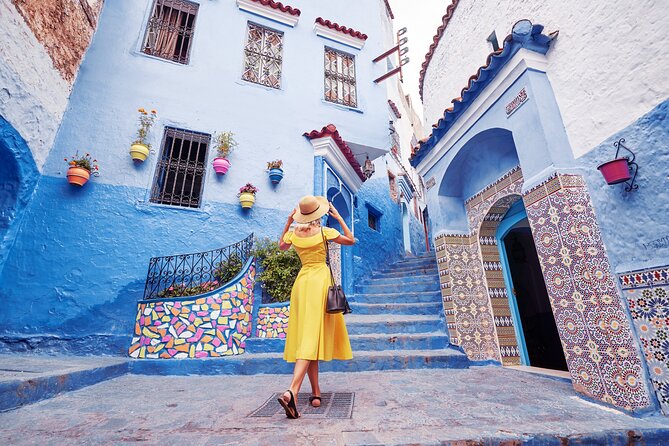
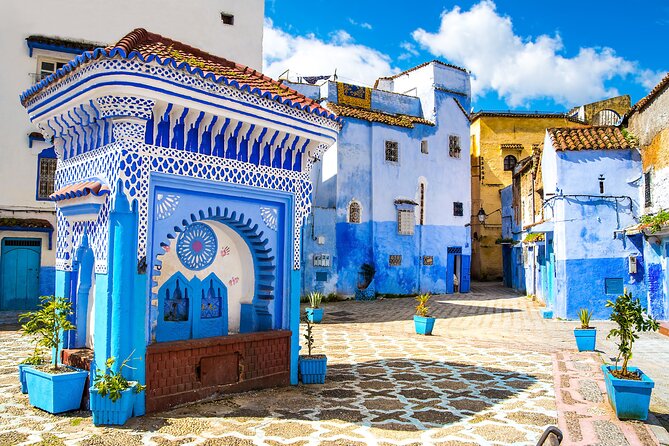
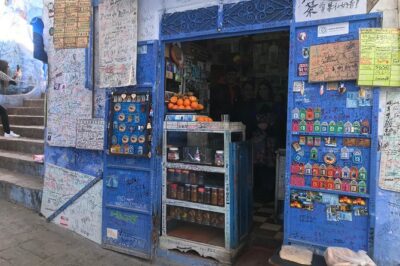
From Tangier, you continue into the Rif Mountains toward Chefchaouen. The city is famous for its blue-painted walls, but its appeal is not only photographic. You can wander through steep lanes, stop at Plaza Outa el Hammam, visit the kasbah garden and museum, and climb toward a rooftop near Hotel Atlas for a wide view over the town.
The route may include a two to three-hour hike to the Cascades d’Akchour if time allows. That phrase matters. This is not a guaranteed centerpiece, so ask before departure if the hike is realistic for your schedule and fitness. Trying to squeeze it in after the Tangier drive could make an already full day feel rushed.
Chefchaouen rewards an early start the next morning. The lanes are quieter, and you can take photos before the day’s activity builds. You cannot enter the Grand Mosque if you are not Muslim, but you can still see it from outside and explore nearby parts of the old town.
I would treat Chefchaouen as a scenic introduction rather than a place with a long list of formal sights. The pleasure is in the color, slopes, doorways, and café stops. Bring shoes with a good grip, since the streets are narrow, steep, and sometimes uneven.
Volubilis, Meknes, and Arrival in Fes
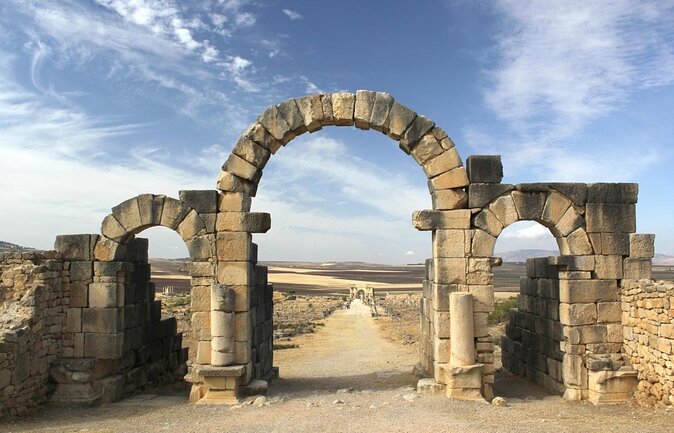
Leaving Chefchaouen, the route heads toward Fes. You can stop at Volubilis, Morocco’s best-preserved Roman ruins and a UNESCO World Heritage site. The large open-air complex includes temples, merchant homes, old heating systems, and colorful mosaics that remain in place.
Volubilis is worth the detour if you enjoy archaeology, but remember that it is exposed and spread out. You will get more from the visit if you are comfortable walking in the open for around two hours. The contrast with Morocco’s Islamic architecture later in the trip makes this stop useful, not just pretty.
Meknes offers a quieter imperial-city visit. The main sights include Bab al-Mansour, the Mausoleum of Moulay Ismail, the Royal Stables, and the medina. Compared with Fes and Marrakech, Meknes is easier to explore at a slower pace.
You can also visit the Bou Inania Madrasa or Dar Jamaï Museum, a former palace with a central collection of Moroccan arts. The itinerary presents Meknes as an optional detour, so confirm how much time you want to spend here before the day begins. A longer Meknes visit means less free time in Fes.
Before entering Fes, the route climbs to the Merenid Tombs. The tombs provide an excellent overlook across historic Fes and the surrounding area. It is a smart first look at the city, since the medina itself can feel like a wall of lanes once you are inside.
That evening, you stay in a riad, a traditional Moroccan house arranged around an interior garden. A riad stay is one of the tour’s more meaningful accommodation choices. It gives you a taste of local architecture rather than placing you only in modern hotels.
Fes Medina: Souks, Tannery, and Tilework
Fes receives a full sightseeing day with a local guide. This is one of the strongest parts of the route because Fes el Bali is difficult to navigate alone. The lanes are narrow, winding, and steep, and it is easy to lose your sense of direction after only a few turns.
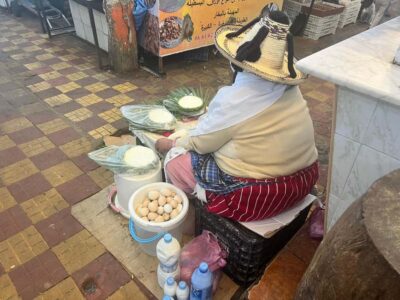
The medina’s souks sell spices, leather, ceramics, pewter, and household goods. You will see the working side of the city rather than a polished museum version of Morocco. Shopping is part of the experience, but you should take your time, compare prices, and never feel obliged to buy.
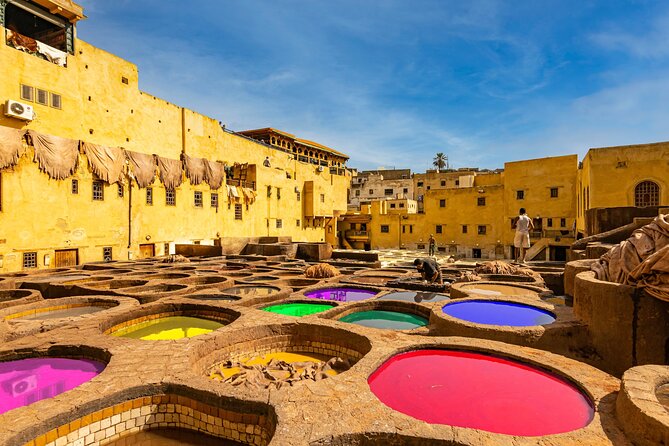
At Chouara Tannery, a local leather shop provides a rooftop view over the traditional dyeing pits. The smell can be strong, and mint leaves may be offered to help with it. This is a working craft site, not a quiet monument, so expect activity and sales pressure around the viewing area.
The route also passes Al-Qarawiyyin University and Mosque, founded in 859. Non-Muslims cannot enter the mosque, but there are places where you may glimpse the decorated interior. The Al Attarine Madrasa and Bou Inania Madrasa show off zellij tilework, carved plaster, and finely worked wood.
Bab Boujloud is the famous gate into the medina. Its exterior is blue, while the inside is green, linked to the color associated with Islam. From here, Talâa Kebira leads into a dense commercial street lined with shops.
Later, you can see Fes el Jedid and the old Jewish quarter, known as the Mellah, along with the Jewish cemetery. The Batha Museum and its Andalusian-style garden are also part of the wider city visit, though the schedule should be confirmed because the supplied itinerary refers to the museum in more than one place.
Wear comfortable walking shoes and keep your day flexible. Fes is not a quick photo stop. It is a sensory, active visit where your guide’s ability to explain the city and keep you oriented makes a real difference.
Same city gate, a very different afternoon:
- From Tarifa: Tangier Full-Day Trip with Lunch
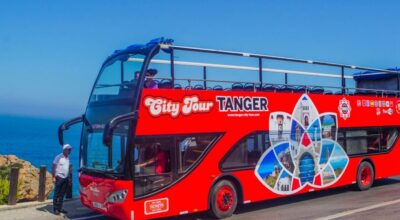
★ 3.8 · 776 reviews - Tangier: Hop-On Hop-Off Sightseeing Bus
★ 4.1 · 769 reviews - From Tangier: Chefchaouen Day Trip with Local Guide
★ 5.0 · 632 reviews - From Tarifa: Tangier Day Trip with Lunch and Ferry
★ 4.3 · 631 reviews
Across the Middle Atlas to Erg Chebbi
Day five is the tour’s biggest driving day. You leave Fes early and head south toward Merzouga, passing through Azrou and the cedar forests of the Middle Atlas. Near the Col du Zad pass, the road reaches 7,146 feet, or 2,178 meters.
The cedar forests are known for Barbary monkeys, and Azrou provides a chance to see them. Lunch comes in Midelt, called the apple city, before the route continues across mountain passes and into the Ziz Valley.
The Ziz Valley changes the look of the journey. Palm clusters, hidden oases, fortified houses, and old ksars line the route. These fortified mud-brick settlements once helped protect valuable goods moving through the region, including gold, salt, and spices.
Erfoud is known for dates and fossils. At an artisan collective, you can see fossil-rich stone being cut and polished into decorative pieces. This stop is interesting because it explains how a local material becomes a finished craft object, though you should remember that workshop visits may also include an invitation to purchase.
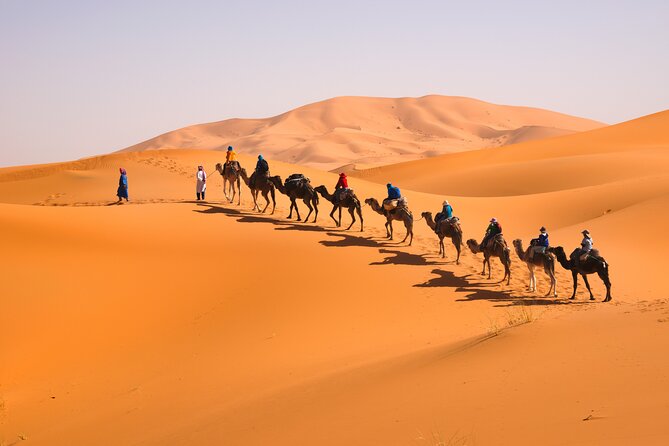
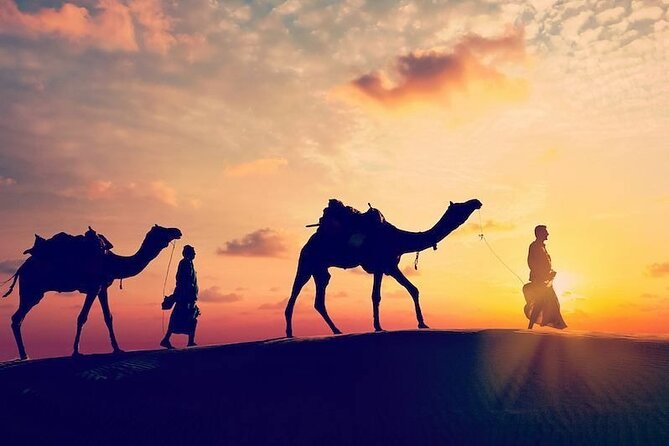
Near Merzouga, you leave the vehicle for a camel ride into the Erg Chebbi dunes. The timing is planned around sunset, so you reach camp before the light fades. Climbing a nearby dune gives you the best chance to watch the sun drop over the sand.
The camp includes a private tent with a toilet and shower. Dinner, a campfire, Berber music, and a night beneath the stars follow. If you prefer more conventional facilities, you can choose an auberge or hotel in Merzouga instead, but the camp is the more memorable option.
Camel riding can be uncomfortable for some people, especially over a longer stretch. Ask about alternatives if needed. Sand also gets into everything, so pack a small overnight bag and keep your main luggage organized.
Sunrise, Khemliya, and the Dades Valley
Wake early for sunrise over Erg Chebbi. This is one of those moments worth the lost sleep. The morning light changes the dunes quickly, and the silence gives the desert a different character from the previous evening.
You can spend more time around the dunes by renting a sandboard, joining a quad ATV outing, taking a tour around Erg Chebbi, or resting near a pool. These activities are not all included in the base price, so ask about costs before choosing one.
Khemliya is a nearby Saharan village whose people originally came from Mali. Traditional drumming and dancing provide a direct cultural encounter, followed by a short walk through the settlement. It is a welcome change from simply looking at desert scenery through a vehicle window.
The next stop is Rissani, entered through an impressive gate. Its traditional market includes a livestock auction and the famous donkey parking area. The market is practical, local, and less polished than the major city souks. Keep your belongings close and follow your guide’s advice around animals and crowded areas.
From Rissani, the route continues through villages and valleys toward Todra Gorge and Dades. The Todra cliffs rise about 300 meters on both sides of a narrow passage. Climbers use the area, but you do not need to climb to appreciate the scale. A short walk and lunch in town are the usual rhythm.
In Dades Valley, look for the rock formation called Monkey’s Fingers and the mud-brick kasbahs along the road. The overnight hotel overlooks the valley, giving you a calmer evening after the desert and a long day on the road.
Ouarzazate, Ait Ben Haddou, and the High Atlas
Ouarzazate is a practical stop on the route toward Marrakech. Its connection to film production gives you the option of visiting one of two movie studios, with sets and props linked to productions such as Black Hawk Down, Prometheus, American Sniper, and Game of Thrones. The Cinema Museum offers another way to explore that local industry.
Ait Ben Haddou is the day’s major sight. The medieval ksour dates from the 11th century and once occupied an important position on the trans-Saharan trade route between Marrakech, Ouarzazate, and the southern desert.
The settlement is built from mud brick, and its position makes it easy to understand why fortified villages were so important here. You have free time to explore and eat lunch in the village before crossing the High Atlas toward Marrakech.
The mountain road reaches about 2,260 meters. Views include rugged peaks and Berber villages set along the mountain sides. Roads through the Atlas can be tiring, especially after several days of driving, but this is also one of the most rewarding sections for scenery.
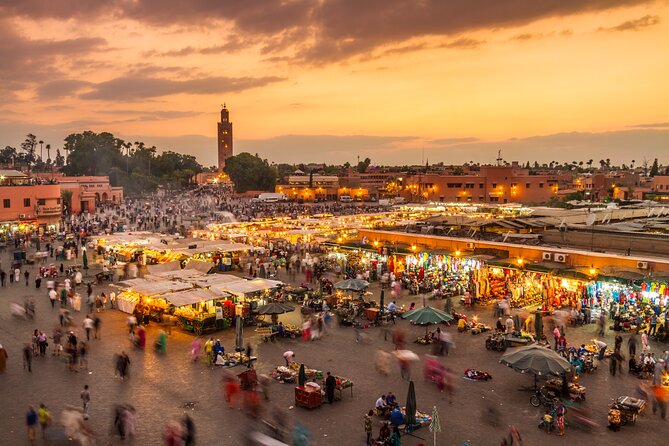
You arrive in Marrakech in the evening. If you still have energy, go to Jemaa el-Fna. Musicians, performers, food stalls, games, and other acts fill the square after dark. A café around the edge lets you watch the action without being in the middle of it.
Marrakech’s Medina and Major Monuments
Your final full day begins with a guided walk through Marrakech’s old city. The medina is crowded, colorful, and full of competing sounds. Souks sell djellabas, babouches, lanterns, spices, and countless small items that are easy to admire and harder to fit into your suitcase.
A guide helps explain the Medina, Souk, and Mellah areas while keeping the walk focused. I would still protect some free time for wandering on your own. Marrakech rewards curiosity, but the lanes can be confusing and persistent shopkeepers may test your patience.
The afternoon includes the Bahia Palace, El Badii Palace, and the Saadian Tombs. Each offers a different view of royal architecture and Moroccan design. The Majorelle Garden provides a quieter change of pace, with strong blue structures, planted paths, and a connection to French painter Jacques Majorelle and designer Yves Saint Laurent.
The garden’s entrance fee is not included. Other entrance fees are also listed separately, so do not assume every monument on the route is covered by the tour price.
What the $1,439.99 Price Really Covers
At $1,439.99 per person, the tour costs about $144 per day before optional expenses. The value is strongest for people who want a private vehicle, prearranged hotels and riads, local guides in Tangier, Fes, and Marrakech, and a desert camp without planning each connection themselves.
Included are airport, hotel, or port transfers; fuel; bottled mineral water during touring; nine nights of accommodation; nine breakfasts; three dinners; the camel ride; and the luxury desert camp. That is a substantial package for a route covering much of Morocco.
You still pay for lunches, six dinners, drinks, personal expenses, tips, and entrance fees. The final bill can rise if you add quad biking, sandboarding, movie studios, or other optional activities. Ask for a clear list of included admissions and optional costs before departure.
The strongest practical advantage is flexibility. This is a private activity for your own group, and the company says the number of days can be changed. Previous praise has focused on fast communication from Med during planning and on drivers such as Said, Tariq, Khalil, and Moha, who were described as friendly, punctual, and willing to adjust the day.
Who Should Book This Morocco Route
I would recommend this tour to first-time visitors who want to see Morocco’s major regions in one trip. It suits couples, families, and friends who value having a driver and do not want to solve transport between distant cities.
It is also a good match for people who want both famous sights and local texture. You get Roman ruins, imperial gates, medinas, mountain passes, desert music, village markets, and fortified kasbahs in one connected route.
I would hesitate if you want slow mornings and long stays in each city. Fes, the Sahara, and Marrakech could each fill several days on their own. The itinerary is ambitious, and the Fes to Merzouga drive is particularly demanding.
Most people can participate, and service animals are allowed. Still, you should be comfortable with several hours in a vehicle, uneven medina streets, steep lanes in Chefchaouen, and walking on sand. Free cancellation is available when you cancel at least 24 hours before the start time. Changes or cancellations inside that window are not accepted for a refund.
Final Verdict: A Strong Choice for a First Morocco Visit
Book this tour if you want Morocco’s biggest sights without handling the transport and hotel planning yourself. The Sahara camp, Fes guide, Ait Ben Haddou, and private door-to-door service give the trip real value.
Skip it if you prefer a slow, independent journey or dislike long drives. For everyone else, this is an efficient and well-supported way to connect northern Morocco with the imperial cities, desert, kasbah country, and Marrakech in ten days.
FAQ
Where does the tour begin and end?
The tour begins with pickup at Tangier airport, port, or hotel. It ends with a transfer to Marrakech Menara Airport or another airport of your choice, depending on your departure arrangements.
Is this a private tour?
Yes. Only your group participates in the activity, and group discounts are available.
How many nights of accommodation are included?
The package includes nine nights at hotels or traditional riads.
Is the Sahara camp included?
Yes. The tour includes a camel ride and one night at a luxury desert camp in a private tent with a toilet and shower. You may choose a hotel or auberge in Merzouga instead.
Which meals are included?
Nine breakfasts and three dinners are included. Lunches, drinks, and six additional dinners are not included.
Can the tour be canceled for a full refund?
Yes, if you cancel at least 24 hours before the experience start time. Cancellations made less than 24 hours before the start time are not refunded, and changes inside that period are not accepted.
Just listed around Tangier
- Walking Tour Of Tangier★ 5.0 · 50 reviews
- Vip Private Tangier Day Trip★ 5.0 · 32 reviews
- Tetouan Tours with Abir★ 5.0 · 27 reviews
- Airport Transfer to Tanger City★ 5.0 · 23 reviews
- Discover Tangier’s flavors★ 5.0 · 25 reviews
- From Tangier: Day Trip to Chefchaouen and Akchour Waterfalls★ 4.5 · 67 reviews
- Tangier Private Guided Walking Tour★ 5.0 · 71 reviews
- Tour of Tangier 3-6 people★ 5.0 · 56 reviews
Tangier Tours, compared.

From Tarifa: Tangier Day Trip with Lunch and Ferry
Read our review →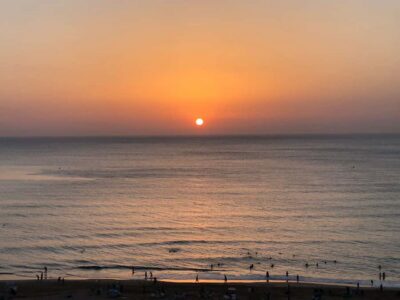
Sunset, Tea, Sweets, Camel Ride, and Hercules Caves
Read our review →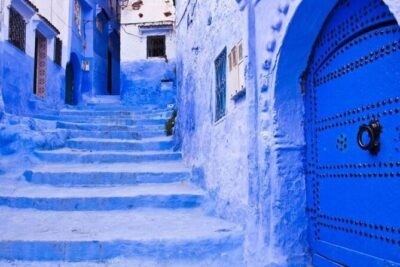
Browse the lists this tour appears in