
Reviewed · SKIP THE LINE
Marrakech: Ben Youssef Guided Tour with Skip-the-Line Entry
Marrakech reveals itself one tiled courtyard at a time. This tour combines a walk through the old souk with a guided visit to Ben Youssef Madrasa, making the monument easier to find and far more meaningful once you arrive. I especially like the route through the Medina and the chance to hear about the school’s students, architecture, and place in Moroccan religious education. My main caution is the meeting point at Café Argana, which can be confusing in the crowded Jemaa el-Fna square, and the entrance fee is only included with the correct booking option.
The visit lasts about 90 minutes to two hours, with roughly 70 minutes at the madrasa. Guides speak Arabic, English, or French, and recent bookings have included guides named Radouan, Ridouan, Ahmed, and Fatah. The strongest praise goes to the guides’ patience, local advice, and ability to explain small details without turning the walk into a lecture.
In This Review
- Key Points Before You Book
- Starting at Café Argana in Jemaa el-Fna
- Walking Through the Medina Before the Madrasa
- Entering Ben Youssef Madrasa
- Reading the Tilework, Wood, and Stucco
- The Student Rooms and Everyday Life
- Koubba Almoravid and Nearby Craft Workshops
- What the $26 Price Really Buys
- Guide Style and Languages
- Timing, Comfort, and Small Drawbacks
- Who Will Enjoy This Marrakech Tour
- Should You Book Ben Youssef Madrasa?
- FAQ
- Where does the tour begin?
- How long does the experience last?
- Is admission to Ben Youssef Madrasa included?
- Does the tour include skip-the-line entry?
- Is hotel or riad pickup included?
- Which languages are available?
- Can I cancel the tour?
- What should I bring?
Key Points Before You Book
- The souk walk is part of the experience: You do not simply meet at the monument. Your guide leads you from Jemaa el-Fna through less familiar Medina lanes and artisan areas.
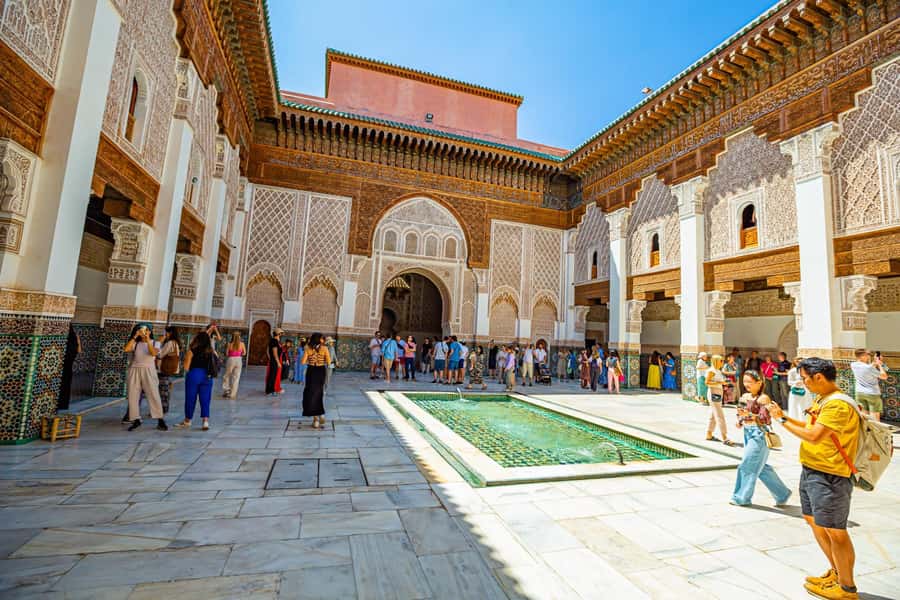
- Ben Youssef is the main event: Expect zellij tilework, carved cedar, stucco decoration, a peaceful courtyard, reflection pools, and plain student rooms.
- Skip-the-line entry saves time: The ticket line is avoided when you choose the option that includes the madrasa entrance.
- The tour is good value at $26: You receive a licensed local guide, guided sightseeing, free time, and monument access if selected correctly.
- Guide quality is a major strength: Radouan and Ridouan receive special praise for patience and useful local suggestions, while Ahmed and Fatah are noted for flexible, lively explanations.
- Wear proper walking shoes: The route passes through narrow Medina lanes, and comfortable footwear, water, sun protection, and a hat are sensible.
Starting at Café Argana in Jemaa el-Fna
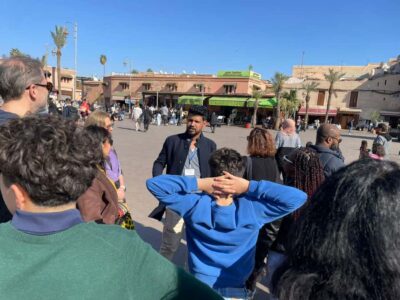
The tour begins at Café Argana, near the main square of Jemaa el-Fna. This is a practical central point, but it is not a quiet one. The square can be crowded, and your guide may be easier to identify after you receive the WhatsApp message sent the day before with the guide’s name and meeting details.
You should arrive a little early. The tour may wait five to ten minutes for late arrivals, but that is not a reason to cut things close. If you cannot find the guide, ask at the meeting point for help rather than wandering into the Medina alone.
Hotel or riad pickup is not included in the standard option. It is available only with the private tour and Medina pickup choice. If you are staying deep inside the old city, check the exact option before paying. The $26 price is attractive, but the booking choices affect what you actually receive.
A few more Marrakech runs to hold up against each other
- Marrakech: Bahia Palace Guided Tour with Skip-the-Line Entry
★ 4.7 · 811 reviews - Marrakech: Bahia Palace Guided Tour – Skip-the-Line Access
★ 4.8 · 146 reviews - Agadir: Crocoparc Skip-the-Line Entry Ticket
★ 4.8 · 1,268 reviews
Walking Through the Medina Before the Madrasa
The walk from Jemaa el-Fna is not just a transfer. It gives you an introduction to the old city before reaching its most famous historic school. Your guide leads you through the souk, pointing out sights, sounds, aromas, workshops, and small details that are easy to miss when you are trying to navigate by yourself.
I like this part because the Medina makes more sense when someone connects its lanes to the city’s past. The route can include lesser-known streets, artisan workshops, and nearby landmarks such as the Koubba Almoravid, one of Marrakech’s oldest surviving structures.
The word maze is accurate here. Narrow passages can bend without warning, and shop-lined lanes may look similar. A local guide saves you from spending your first hour staring at a phone map. You can pay attention to doors, craftwork, courtyards, and the rhythm of daily life instead.
There is also a shopping element, so be prepared for the possibility of stops near artisan areas. That can be useful if you want local craftwork or advice about authentic souvenirs. Radouan was praised for suggesting places away from the most tourist-focused shops, as well as a hammam worth considering.
Still, keep your own priorities clear. If you dislike browsing shops, tell the guide politely at the start. The tour includes free time and sightseeing, but the exact balance may depend on the group and guide.
Entering Ben Youssef Madrasa
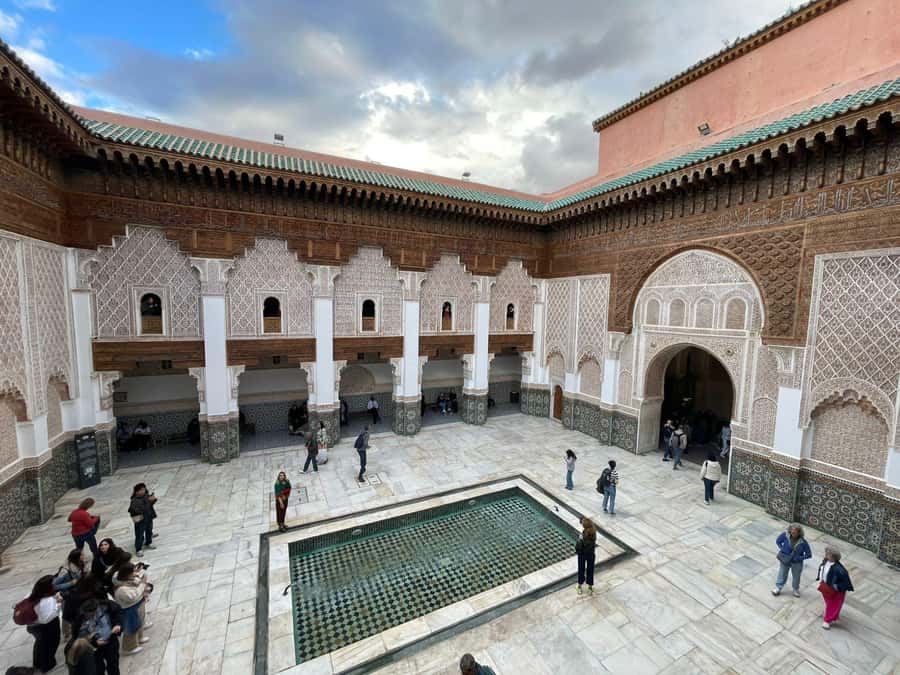
Ben Youssef Madrasa is the central attraction, and you spend about 70 minutes here. Built originally in the 14th century and later renovated by the Saadian dynasty in the 16th century, it served as a Quranic school and a major place of Islamic learning.
The madrasa was once the largest Islamic college in North Africa. Students came from across the Muslim world, and the school also provided living quarters. That context changes how you read the building. It was not designed only to impress visitors. It was a working institution for study, prayer, and daily life.
The skip-the-line arrangement matters most here. If you choose the option with entrance included, you can avoid waiting at the ticket line and move directly inside with the guide. The standard entrance fee is 50 MAD when it is not included, so read the booking choice carefully. A low advertised price can become less simple if you assume every option covers admission.
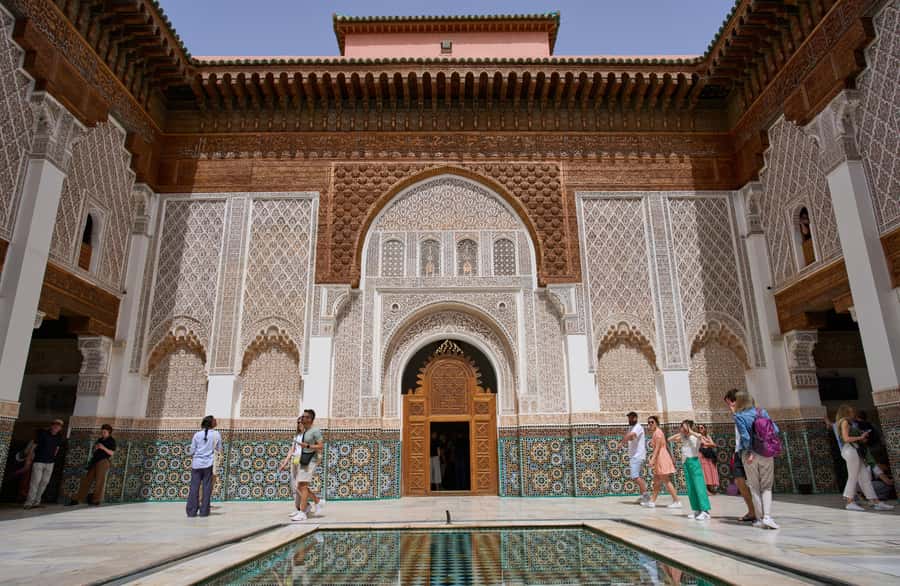
Once inside, the architecture does the talking. The courtyard is framed by geometric decoration, carved cedarwood, and detailed stucco work. Zellij tiles form precise patterns in bright, carefully arranged colors. You can spend plenty of time photographing the surfaces, but a guide helps explain how these elements fit together.
The courtyard has a calmer feel than the streets outside. Reflection pools and ordered designs create a clear contrast with the tight Medina lanes. This change of mood is one reason the tour works well: you feel the city’s noise behind you, then enter a place built around study and quiet attention.
Reading the Tilework, Wood, and Stucco
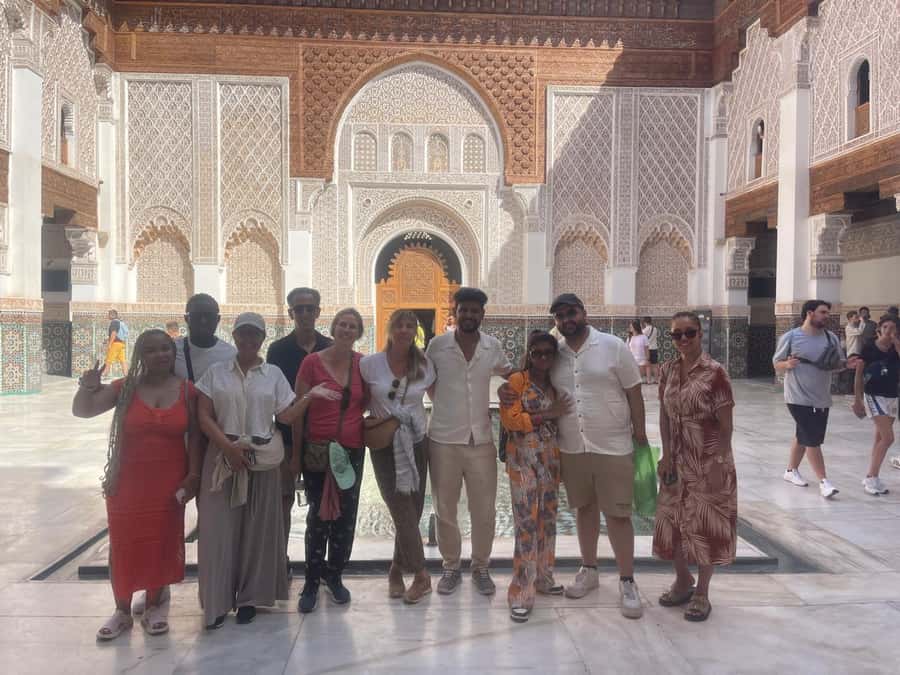
The decoration deserves more than a quick photo stop. Zellij tilework uses small geometric pieces arranged into complex patterns. The cedarwood carvings add warmth above the tiled lower walls, while stucco provides fine surface detail around doors and arches.
A guide can point out details that blend together when you first look at the courtyard. The best explanations focus on the relationship between geometry, craft, and religious architecture rather than simply naming materials.
The tour’s guides have been praised for answering questions and adjusting explanations to the group. Ahmed, for example, was described as flexible and full of interesting anecdotes. Fatah was praised for a lively and patient approach. Those traits matter in a building like this, where you may want a short overview or a closer look at several design elements.
You also receive free time to explore. This is important because a guided visit can otherwise feel rushed. Recent tour arrangements have allowed people to walk around the madrasa independently while the guide waited at an agreed place.
Use that time for photographs and a slower look at the courtyard. The tile patterns are easy to appreciate at a glance, but the carved wood and stucco reward patience. Bring a camera, but remember that a hat, sunscreen, and water may be more important for the walk before and after the visit.
Same city gate, a very different afternoon:
- Marrakech: Agafay Desert Sunset, Camel Ride, and Dinner Show
★ 4.6 · 35,119 reviews - From Marrakech: Ouzoud Waterfalls Guided Hike and Boat Trip
★ 4.7 · 33,630 reviews - Marrakech: Agafay Desert Quad & Camel Rides with Dinner Show
★ 4.8 · 27,382 reviews - Marrakech: Agafay Desert Quad Biking Tour with Dinner-Show
★ 4.8 · 16,569 reviews
The Student Rooms and Everyday Life
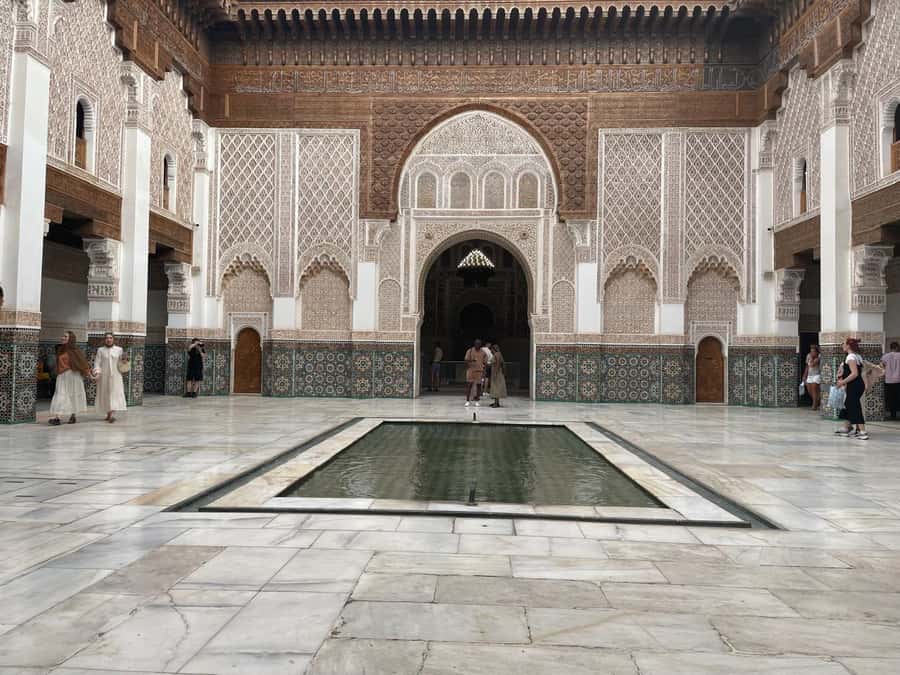
The small dormitory rooms provide the most human part of the visit. Up to 900 students once lived at the madrasa, in spaces that were plain and austere compared with the courtyard.
This contrast is useful. The courtyard shows the institution’s public and ceremonial face, while the rooms suggest the daily life behind it. Students came to study, lived simply, and shared a setting that placed learning at the center of their routine.
I would pay close attention when the guide discusses the students and the school’s role. Dates and dynasties are easier to remember when connected to people who actually used the building. The tour’s explanation of Islamic education in Morocco helps you see Ben Youssef as more than a beautiful structure.
The rooms are small, so you may not linger in the same way as in the courtyard. If you are tall, have mobility concerns, or prefer spacious sites, take your time and follow the guide’s directions. The activity is described as wheelchair accessible, though the Medina approach remains a busy walking route.
Koubba Almoravid and Nearby Craft Workshops
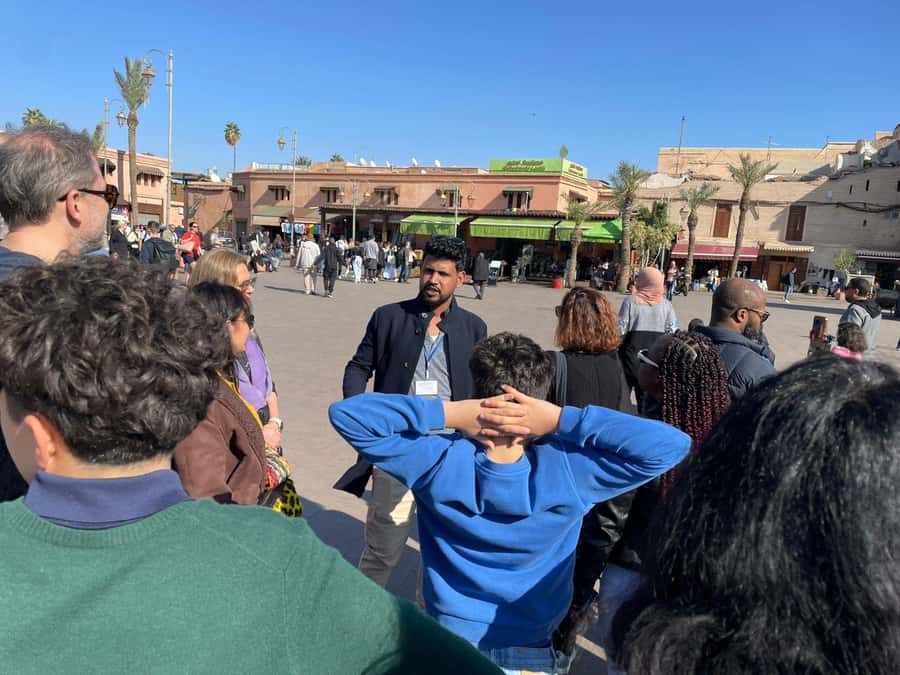
The route can also pass the Koubba Almoravid and nearby artisan workshops. The Koubba offers a link to an earlier period of Marrakech, while the workshops connect the old city’s architecture with living craft traditions.
These stops add scale to the tour. Ben Youssef tells you about formal education and religious life. The surrounding streets show how the Medina still functions as a place of trade and skilled work.
Do not expect a long, separate visit at every landmark. Some stops are photo opportunities or brief explanations rather than full museum-style visits. That is reasonable for a tour lasting less than two hours, but you should book a longer Medina experience if you want extended shopping, several monuments, or a detailed visit to each site.
The route finishes back near Café Argana or another central Medina location, depending on the exact arrangements. That makes it easy to continue exploring Jemaa el-Fna afterward, but it does not include transportation back to your hotel or riad.
What the $26 Price Really Buys
At $26 per person, this is a sensible price for a guided introduction to one of Marrakech’s most important monuments. You are paying for a licensed local guide, organized entry, a route through the souk, historical context, and time to explore the madrasa on your own.
The value is strongest if you are new to Marrakech. A self-guided visit may cost less, but you would need to find the entrance, understand the building’s role, and navigate the Medina without help. The guide also adds practical local advice, such as suggestions for souvenir shopping or a hammam.
The value is less clear if you already know the Medina well or prefer to read at your own pace. The tour includes shopping and free time, so the experience may not feel tightly controlled from start to finish. That flexibility suits many people, but visitors seeking a very formal art-history lecture should set their expectations accordingly.
A private group is available. That option may be worth considering if your party wants more control over the pace, has specific questions, or prefers not to share the guide. A shared tour can be perfectly enjoyable, especially when the group is small. One recent group had only a guide and three customers, though group size can vary.
Guide Style and Languages
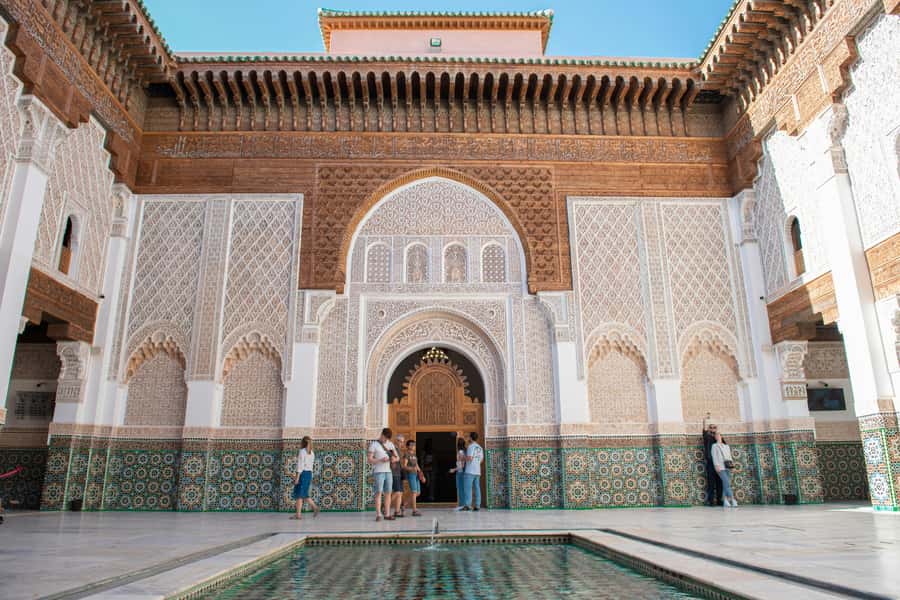
The guide is the heart of this experience. The licensed local guides speak Arabic, English, or French, and the strongest feedback centers on their warmth, patience, and ability to explain Marrakech beyond the main monument.
Radouan was praised for being prepared, helpful, and good at drawing attention to small details. Ridouan received praise for explaining both the madrasa and the city, allowing independent time inside the building, and offering useful suggestions for authentic shopping. Ahmed was noted for adapting to the group’s interests, while Fatah was described as patient and thorough.
You should feel free to ask questions. The tour covers the madrasa, the Saadian period, the Medina, Islamic education, and nearby landmarks, but the guide can often make the difference between a list of facts and a memorable visit.
Language is worth checking at booking. Arabic, English, and French are available, but you should confirm the language you need when selecting the activity.
Timing, Comfort, and Small Drawbacks
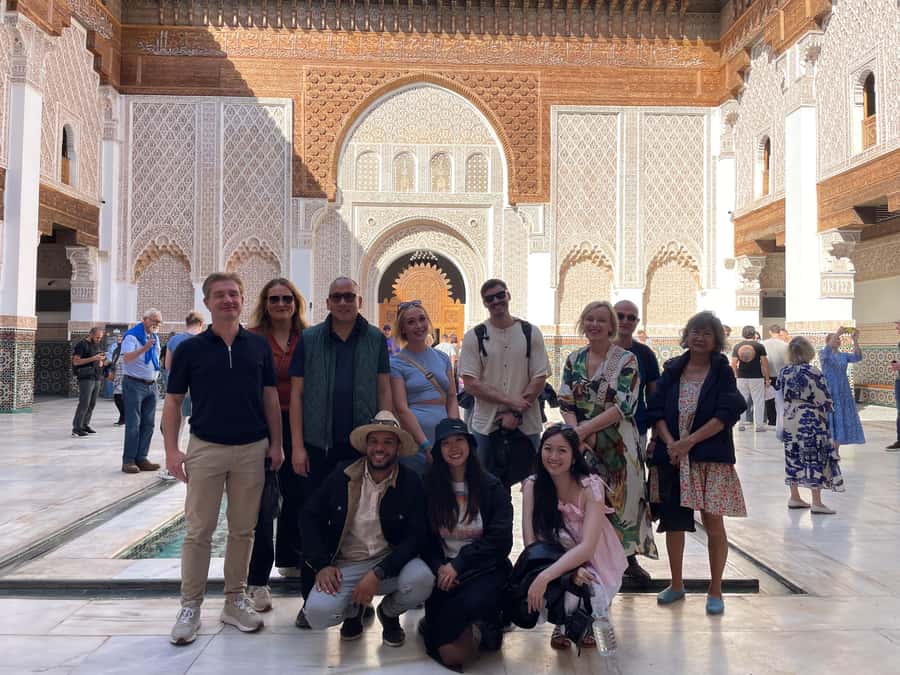
The listed duration is 90 minutes to two hours. That is long enough for a solid introduction without taking over your day. It also leaves time to return to the square, continue shopping, or visit another part of Marrakech.
The main physical demand is walking. The souk has narrow lanes, and you should wear comfortable shoes. A hat, sunscreen, water, and a camera are sensible additions, particularly if the day is hot.
The meeting point is central, but pickup is not standard. You also need to confirm that your selected option includes the madrasa entrance. These are small details, but they are the sort that can create frustration if overlooked.
The five to ten minute delay for late arrivals is another practical note. It shows some flexibility, but you should still arrive on time. A delayed start can reduce your free time or compress the route.
Free cancellation up to 24 hours before the activity and reserve-now, pay-later booking make the tour easier to fit into an uncertain schedule. Those terms are useful for a first day in Marrakech, when weather, flight delays, or Medina navigation can change your plans.
Who Will Enjoy This Marrakech Tour
I would recommend this tour to first-time visitors who want a clear introduction to the Medina and Ben Youssef without arranging several separate visits. It suits couples, families with older children, and small groups that prefer a local guide over a written description.
It is also a good choice if you want practical help beyond the monument. The advice about authentic souvenirs and a worthwhile hammam can be useful when you are still learning how Marrakech works.
You may prefer a private option if your group wants to set the pace or spend extra time photographing details. Independent visitors who dislike shopping stops should mention that preference early.
The tour is less suitable if you want a full-day historical walk. The schedule gives you a focused look at Ben Youssef and nearby Medina sights, not an exhaustive tour of every major monument.
Should You Book Ben Youssef Madrasa?
Yes, if you want a short, well-priced introduction to Marrakech that joins the souk with one exceptional historic building. The architectural detail is the main reward, while the guide adds context about students, Islamic learning, the Saadian dynasty, and the old city.
Choose the entrance-included option, confirm the language, and meet at Café Argana early. Wear shoes made for uneven walking, keep water handy, and tell your guide if you want less shopping or more time with the architecture.
I would skip it only if you already know the Medina well and prefer exploring entirely alone. For most first visits, the $26 cost is fair, the route is useful, and the guide’s local knowledge gives the madrasa a human meaning that photographs cannot provide.
FAQ
Where does the tour begin?
The meeting point is Café Argana at the main square of Jemaa el-Fna in Marrakech. Customer service sends a WhatsApp message the day before with the guide’s name and meeting details.
How long does the experience last?
The tour lasts between 90 minutes and two hours. The visit at Ben Youssef Madrasa is scheduled for about 70 minutes.
Is admission to Ben Youssef Madrasa included?
Admission is included only when you select the option that includes the madrasa entrance. If you choose an option without admission, the entrance fee is 50 MAD.
Does the tour include skip-the-line entry?
Yes, skip-the-line entry to the monuments is included with the activity. You should still check that your selected booking option includes the madrasa entrance fee.
Is hotel or riad pickup included?
Pickup is available only with the Private Tour and Medina Pickup option. Transportation to and from the standard meeting point is not included.
Which languages are available?
The live guides speak Arabic, English, and French. Confirm your preferred language when booking.
Can I cancel the tour?
You can cancel up to 24 hours in advance for a full refund. Reserve-now, pay-later booking is also available.
What should I bring?
Bring comfortable shoes, a hat, sunscreen, water, and a camera. The route includes walking through the Medina and souk.
Just listed around Marrakech
- 3 Days To Merzouga Desert★ 5.0 · 19 reviews
- 3 Days Shared Sahara Desert Tour From Marrakech★ 5.0 · 78 reviews
- 1 night Camel Treking in Merzouga Desert Luxury Camp★ 5.0 · 132 reviews
- 3 Days Sahara Desert Trips From Marrakesh★ 5.0 · 176 reviews
- 3 Days Sahara Tour from Marrakech to Merzouga Dunes★ 5.0 · 29 reviews
- trip of your dreams in 3 days and 2 nights in the desert★ 5.0 · 36 reviews
- 3 Days Private Tour to Merzouga Desert from Marrakech★ 5.0 · 77 reviews
- 3 Day Sahara Desert Tour From Marrakech★ 5.0 · 49 reviews
Skip the Line, compared.
Bahia Palace Guided Tour with Skip-the-Line Entry
Read our review →
Skip the line Hassan 2 mosque Premium Tour entry ticket included
Read our review →
Skip the Line Ticket to Crocoparc with Optional Transfert
Read our review →
Bahia Palace Guided Tour – Skip-the-Line Access
Read our review →
Skip the line Hassan II Mosque guided Tour entry tickets included
Read our review →Browse the lists this tour appears in