
Reviewed · BERBER VILLAGE TOURS
3-Day Desert Tour to Fez: Ouarzazate and Berber Village from Marrakech
The desert is only the middle of the story. This three-day trip links Marrakech and Fez by way of the High Atlas, ancient kasbahs, rose country, Berber villages, and the Sahara. I like the route because it gives you far more than a quick camel ride: you see Aït Benhaddou with a guide, walk beside the Todgha River, and spend a night in Erg Chebbi beneath desert skies.
I also like the practical one-way design. You begin in Marrakech and finish at your Fez riad or hotel, saving you the trouble of returning to Marrakech. The included camel trek, two dinners, two breakfasts, and two nights of lodging make the $230.30 price reasonable, though lunches, drinks, and long hours in the vehicle can test your patience.
- Aït Benhaddou gives the first day a strong start, with a guided walk through the famous fortified village.
- The Valley of Roses and Kelaa Mgouna add a working, local stop, not just another roadside photo break.
- The Todgha River walk lets you meet village life at a slower pace before the dramatic gorge.
- The Erg Chebbi camel ride leads directly to a desert camp, with dinner and a night in a private tent.
- The return route crosses the Ziz Valley and Middle Atlas, including cedar forests, Berber towns, and Ifrane.
- The tour is best for people who value variety over free time, since the schedule covers long distances in just three days.
In This Review
- What This Route Really Covers in Three Days
- Day One: High Atlas Roads and Aït Benhaddou
- Ouarzazate, Skoura, and the Valley of Roses
- Day Two: The Road of 1,000 Kasbahs
- Erfoud, Merzouga, and the Erg Chebbi Camel Ride
- Day Three: Ziz Valley to the Middle Atlas
- Is $230.30 a Fair Price?
- Comfort, Clothing, and What to Pack
- Who Should Book This Desert Tour?
- Should You Book It?
- FAQ
- Where does the tour start?
- Where does the tour end?
- What time does pickup begin?
- Is the camel ride included?
- What accommodation is provided?
- Are meals included?
- Do I need to bring a sleeping bag?
- How large can the group be?
What This Route Really Covers in Three Days
This is not a lazy desert holiday. It is a moving road trip across Morocco, with plenty of stops but also plenty of driving. You leave Marrakech at about 7:00 in the morning, cross the High Atlas, reach the desert near Merzouga on the second day, and arrive in Fez late on the third day, around 8:00 in the evening.
That tradeoff is the point. You get a practical connection between two major cities while seeing places that would otherwise require separate excursions. The route includes mountain passes, palm oases, kasbahs, rose farms, gorges, dunes, and cedar country.
The group can reach a maximum of 15 people. On the final day, you say goodbye to the Marrakech-bound group and transfer to a new vehicle headed for Fez, with a maximum of six passengers. That smaller final van should make the longest driving day more comfortable, although the change of vehicle and driver is worth knowing in advance.
The trip is operated by Ando Travel SARL. A guide named Rarhib has received especially warm praise for being present and helpful throughout the journey. Guides can shape this sort of trip, since the scenery is only half the experience. The other half is understanding what you are seeing.
Day One: High Atlas Roads and Aït Benhaddou
Your pickup begins in Marrakech. If your riad sits on a lane too tight for the minibus, you will be collected at a nearby meeting point. That is common in the old city, so allow a little time to walk out with your luggage.
The first major crossing is the Tizi-n-Tichka pass in the High Atlas. The road climbs into mountain country where Berber farming communities have worked the land for generations. You will want sturdy shoes and a camera, but keep your attention on the road too. The mountain crossing is scenic, yet it is not a quick hop over the hills.
Aït Benhaddou is the day’s headline stop. This UNESCO-listed kasbah is a fortified earthen village made up of narrow lanes, passageways, and tall defensive walls. With a guide, you get more than a short walk and a few photographs. You hear how the settlement was built and why it has attracted film crews and photo shoots.
The site is worth taking at a measured pace. Look closely at the mud-brick construction and the way the village rises above the surrounding area. You will also need comfortable walking shoes, since the visit involves uneven ground and uphill sections.
Lunch here is at your own expense. That pattern continues through the trip, so keep Moroccan dirhams available for meals and drinks. The tour includes breakfast and dinner, but not standard lunches.
More Berber village visits near Marrakech:
- Berber villages : Atlas Mountains Day Hike from Marrakech
★ 5.0 · 14,007 reviews - Marrakech: Balloon Flight, Berber Breakfast & Certificate
★ 4.8 · 8,164 reviews - Marrakech: Majorelle Garden, YSL, and Berber Museum Entry
★ 4.6 · 5,168 reviews
Ouarzazate, Skoura, and the Valley of Roses
After Aït Benhaddou, the road reaches Ouarzazate, often called the Gate of the Sahara. The city is a useful marker on the route, shifting the feel of the journey from mountain crossing to desert approach.
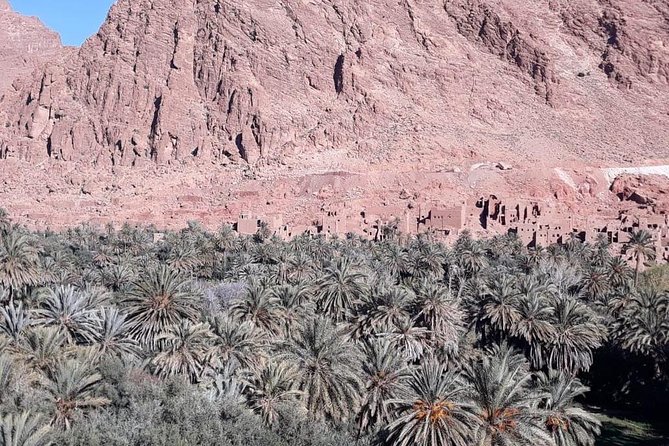
The next section passes through the Skoura oasis, where palm trees and olive groves provide a welcome change from the dry mountain roads. The stop at Kasbah Amridil adds another layer to the day. Your guide explains its construction and history, helping you understand how these kasbahs functioned as homes, defensive buildings, and centers of local life.
The Valley of Roses brings a different kind of stop. At Kelaa Mgouna, you visit a rose-growing plantation and cooperative. The attraction here is not grand architecture. It is the connection between agriculture, local products, and the dry valley environment.
A cooperative visit can feel more commercial than the outdoor stops, so keep your expectations sensible. Its value is seeing how rose farming supports local work and seeing the products made from the crop. You do not need to buy anything for the stop to be worthwhile.
The day continues toward Boumalne du Dadès and the Dades Gorges area, where you spend the first night at Kasbah Dades Amazigh or Kasbah Chems Dades. One stay is noted as having a pool, which can be a pleasant surprise after a long drive. Accommodation is included, but the exact property may vary.
Day Two: The Road of 1,000 Kasbahs
After breakfast, you follow the Road of 1,000 Kasbahs through the Dadès Valley. The name is poetic rather than a promise that you will count a thousand buildings, but it captures the repeated sight of fortified homes and earthen structures along the route.
You visit one of the valley’s traditional kasbahs and hear about its place in the region. This is where a good guide matters. Without explanation, a kasbah can look like another old brown building. With context, you begin to see how the buildings fit the valley’s trade, farming, and defense patterns.
The route then reaches Tinghir, an oasis town in the High Atlas foothills. Here you take a one-hour walk beside the Todgha River. Palm trees and olive groves grow along the banks, creating a cool green strip in an otherwise dry region.
I consider this one of the most valuable parts of the tour. The walk slows the pace and gives you a clearer sense of how people live in the area. You also visit Berber villages and meet one or two local residents with your guide. The encounter is brief, so do not expect a full cultural program, but it is more personal than simply viewing the valley from a minibus.
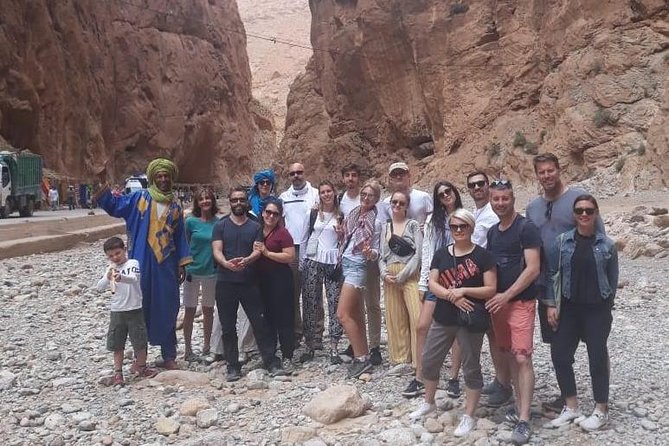
Afterward, you reach the Todgha Gorge for lunch at your own expense. The gorge is famous for its steep rock walls and narrow passage. It is an impressive setting, but this is still a group itinerary, so your time for walking and photographs will be limited by the day’s schedule.
The second day is listed at about eight hours for the Dades Gorges section, followed by the road toward the desert. That gives you a realistic idea of the pace. Wear shoes that can handle both a river walk and rough ground, and keep sunscreen and sunglasses close at hand.
Erfoud, Merzouga, and the Erg Chebbi Camel Ride
The route continues through Erfoud and Merzouga, two important stops before the dunes. Erfoud is associated with the Tafilalt region and is a gateway to the desert. Merzouga is the launch point for the Erg Chebbi camel trek.
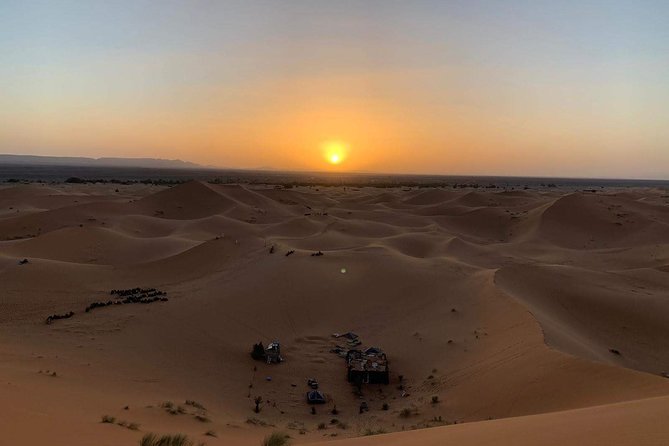
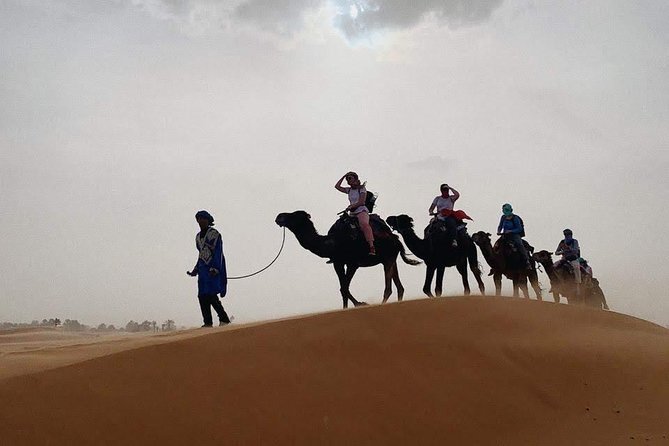
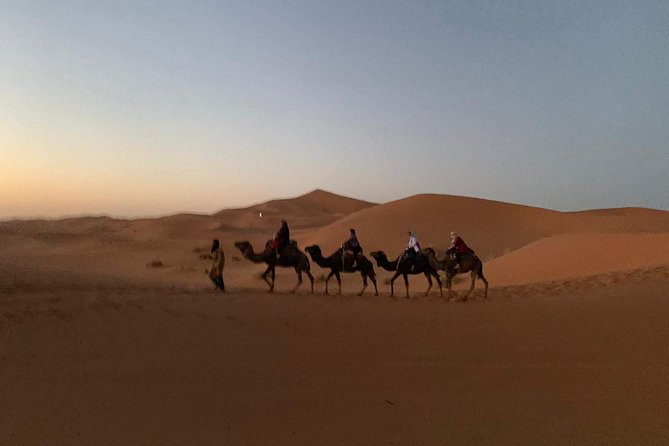
At Erg Chebbi, you meet the camel train and ride into the Sahara. The camel trek lasts about an hour according to the schedule. It is long enough to give you the classic desert arrival without making the entire evening a saddle endurance test.
Wear long trousers. Camel saddles can rub your legs, and loose, comfortable clothing will be more useful than anything stylish. A conservative dress code is recommended throughout Morocco, with shoulders and knees covered for cultural respect. The desert can also turn cold after sunset, especially in winter, so bring a warm layer.
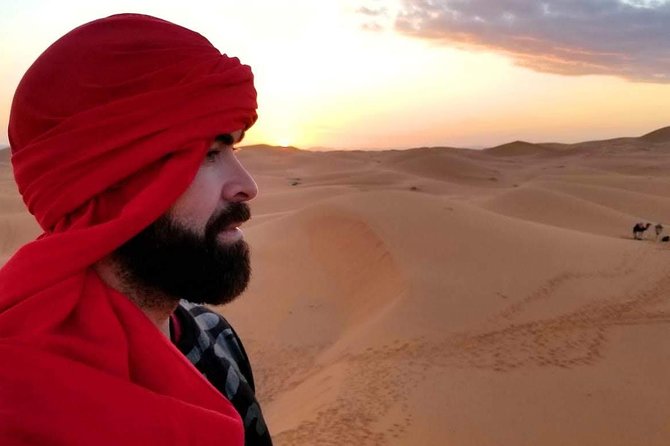
The ride is timed around sunset, giving you changing views as the dunes catch the fading light. You then reach the camp for dinner and your overnight stay. The tent is private, but bathroom facilities are shared. Bedding is supplied, so you do not need to carry a sleeping bag.
That arrangement is comfortable enough for most people who want a desert night without signing up for a hard expedition. Still, shared bathrooms and basic camp conditions are part of the deal. If you need hotel-style facilities, this will feel simple.
The dinner is included, as is the following breakfast. Drinking water is not supplied, but you can buy it along the route. Buy enough before reaching the camp rather than assuming a bottle will always be available when you want one.
A few more Marrakech runs to hold up against each other
- From Marrakech: 3-Day Merzouga and Sahara Desert Tour
★ 4.9 · 15,308 reviews - From Marrakech: Merzouga 3-Day Desert Safari with Food
★ 4.7 · 12,232 reviews - 3 Days Desert Tour From Marrakech To Merzouga Dunes & Camel Trek
★ 5.0 · 10,125 reviews - 3-Day Marrakech to Merzouga Desert Tour: Camel Rides & Overnights
★ 5.0 · 8,734 reviews
Day Three: Ziz Valley to the Middle Atlas
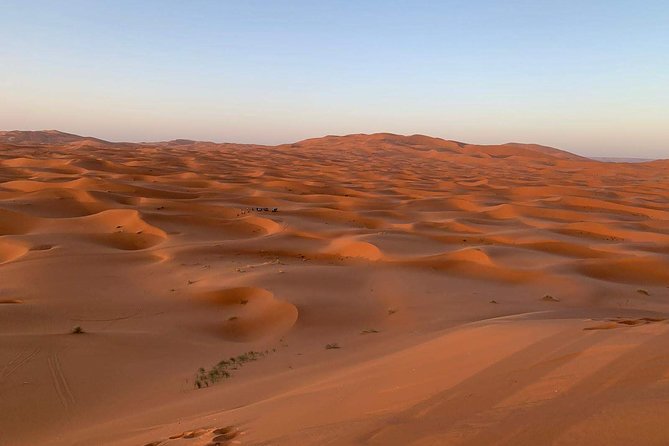
The third day starts with an early desert sunrise. This is one of the best reasons to accept the early start. The dunes look different in the first light, and the cooler temperature makes the walk outside more pleasant.
After breakfast, you leave the desert and cross the Ziz Valley through Errachidia, the capital of the Tafilalt region. The scenery changes again as the route moves away from the dunes. You then continue toward Midelt, where you stop for lunch at leisure.
Midelt is a useful break in what becomes a long transfer day. Lunch is not included, so budget for it separately. The stop is short, listed at about 20 minutes, which means you should not count on a long meal or an extended visit.
From Midelt, the road crosses the Middle Atlas Mountains. The route passes cedar forests and Berber towns including Imouzzer and Ifrane. This final section shows a very different Morocco from the desert. Instead of palms and sand, you see mountain vegetation and cooler highland country.
You arrive in Fez late in the afternoon or around 8:00 in the evening. The tour ends with drop-off at your Fez riad or hotel of choice. That door-to-door finish is a major practical benefit, especially if you are carrying luggage and do not want to arrange another transfer after a full day on the road.
Is $230.30 a Fair Price?
At $230.30 per person, the value is good if you want transportation between Marrakech and Fez plus a broad collection of stops. The price covers the camel trek, two nights of accommodation, two breakfasts, two dinners, and the main shared touring arrangements.
The cost becomes less attractive if you want a private vehicle, long visits at each site, or hotel-level comfort. Lunches and drinks are extra, and you should also allow for any optional local guides or purchases at the rose cooperative.
The tour’s strongest financial advantage is the route. You are not paying only for a camel ride. You are also covering the long connection between two cities while visiting Aït Benhaddou, Ouarzazate, Skoura, the Valley of Roses, Tinghir, the Todgha Gorge, Erfoud, Merzouga, the Ziz Valley, Midelt, and the Middle Atlas.
The downside is time. A private trip could give you more control over stops, but it would cost more. Here, you trade flexibility for a lower price and the ease of having the route arranged.
Comfort, Clothing, and What to Pack
This is a road trip with several kinds of walking, so packing lightly and sensibly will help. I would bring:
- Good walking shoes for kasbah lanes, river paths, and gorge ground
- Sunscreen and sunglasses
- Long trousers for the camel ride
- Warm clothing for the desert night and winter mountain roads
- Water money, since water is available for purchase but not provided
- Clothing that covers the shoulders and knees
The tour is not recommended for children under two years old. Most people can participate, but the long drives and early desert start may not suit anyone who needs a slow, relaxed schedule.
The maximum group size is 15, which is small enough to keep the experience manageable but large enough that stops will not always move at your preferred speed. The final Fez vehicle has a maximum of six passengers, and that change can make the last day feel less crowded.
Who Should Book This Desert Tour?
I would choose this tour if you want to see several sides of Morocco in one compact journey. It suits people who are visiting Marrakech and Fez on the same trip and want the route between them to become part of the holiday rather than a plain transport day.
It is especially good for first-time visitors who want a guided introduction to kasbah architecture, Berber villages, oasis farming, and desert camping. The mix of famous sights and smaller stops gives the trip more substance than a quick Marrakech to Merzouga excursion.
I would think twice if you dislike long drives, shared bathrooms, early mornings, or fixed group schedules. The tour covers a great deal of ground in three days, and you cannot linger wherever you like.
The strongest parts are the variety, the one-way route, and the balance of famous places with working rural communities. The weakest part is simply the clock. You get a lot, but you have to keep moving.
Should You Book It?
Book this tour if your priority is seeing Morocco’s desert route efficiently while traveling from Marrakech to Fez. The included camel ride, camp night, dinners, breakfasts, kasbah visits, and city drop-off make the $230.30 fare a solid deal.
Choose a longer private itinerary instead if you want more time in Aït Benhaddou, the Dades Valley, or the Sahara. For most people with only three days, though, this is a well-packed route with real variety, practical transport, and a memorable night in the dunes.
Cancellation is free if you cancel at least 24 hours before the 7:00 a.m. start time. Changes or cancellations made later are not accepted for a refund.
FAQ
Where does the tour start?
The tour starts in Marrakech with pickup at your hotel or riad. If a minibus cannot reach your riad, pickup will be arranged at a nearby location.
Where does the tour end?
The tour ends in Fez, with drop-off at the Fez riad or hotel of your choice.
What time does pickup begin?
The scheduled start time is 7:00 a.m.
Is the camel ride included?
Yes. A camel trek in Erg Chebbi is included, with the ride into the desert taking about one hour.
What accommodation is provided?
The first night is at Kasbah Dades Amazigh or Kasbah Chems Dades. The second night is in a private tent at a Sahara desert camp with shared bathroom facilities.
Are meals included?
Two breakfasts and two dinners are included. Lunches and drinks are not included unless specifically stated.
Do I need to bring a sleeping bag?
No. Bedding is provided at the desert camp.
How large can the group be?
The tour can have a maximum of 15 participants. On the final transfer to Fez, the replacement van has a maximum of six passengers.
Just listed around Marrakech
- 3 Days To Merzouga Desert★ 5.0 · 19 reviews
- 3 Days Shared Sahara Desert Tour From Marrakech★ 5.0 · 78 reviews
- 1 night Camel Treking in Merzouga Desert Luxury Camp★ 5.0 · 132 reviews
- 3 Days Sahara Desert Trips From Marrakesh★ 5.0 · 176 reviews
- 3 Days Sahara Tour from Marrakech to Merzouga Dunes★ 5.0 · 29 reviews
- trip of your dreams in 3 days and 2 nights in the desert★ 5.0 · 36 reviews
- 3 Days Private Tour to Merzouga Desert from Marrakech★ 5.0 · 77 reviews
- 3-Days Private Tour from Marrakech to Fez through Merzouga Desert★ 5.0 · 29 reviews
Berber Village Tours, compared.
Berber villages : Atlas Mountains Day Hike from Marrakech
Read our review →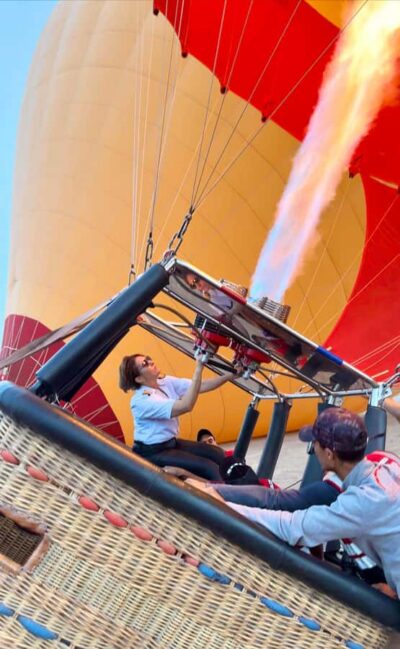
Balloon Flight, Berber Breakfast & Certificate
Read our review →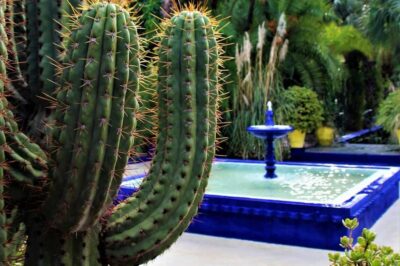
Majorelle Garden, YSL, and Berber Museum Entry
Read our review →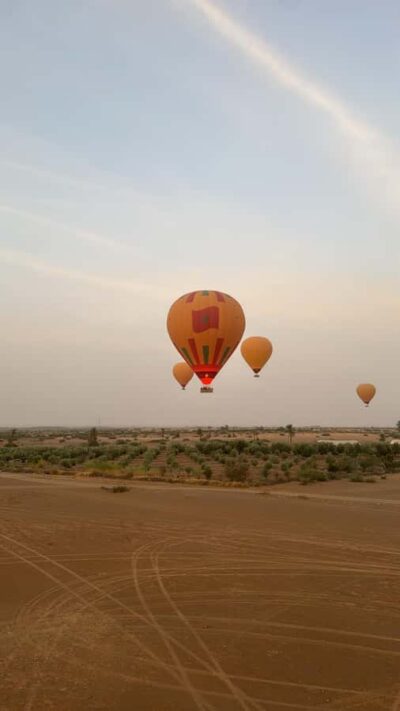
Hot Air Balloon Flight with Berber Breakfast
Read our review →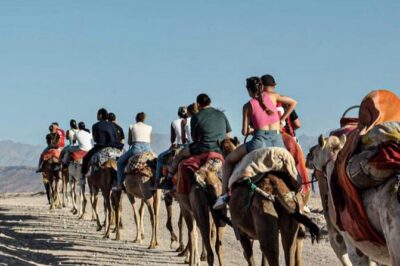
Atlas Mountains, Berber Villages and Three Valleys all inclusive
Read our review →
Atlas Mountains Hot Air Balloon Ride from Marrakech with Berber Breakfast and Desert Camel Experience
Read our review →
Atlas Mountains, Berber Villages, Agafay & Camel Ride
Read our review →
Balloon Flight, Berber Breakfast, and Camel Ride
Read our review →Browse the lists this tour appears in