
Reviewed · VIP
Casablanca luxury day tour
Casablanca rewards a long day. This private trip gives you a broad look at Morocco’s Atlantic capital, from the Hassan II Mosque and the Corniche to the Habous quarter, historic villas, and film-inspired sights. The route is ambitious, but it helps you understand how Casablanca differs from Marrakech.
I especially like the private format, which lets you set the pace, and the chance to explore Hassan II Mosque with a guide rather than simply viewing it from outside. Guides such as Noor have earned praise for their English, local insight, patience, and willingness to suggest good places to eat. The main concern is the long drive from Marrakech and the uneven vehicle experience reported by one guest, which makes the luxury label worth treating with caution.
In This Review
- Key things to know before booking
- The long road from Marrakech to Casablanca
- Hassan II Mosque and its ocean setting
- Casablanca’s movie connection in the city center
- Ain Diab and the Atlantic Corniche
- Anfa, French-era villas, and wartime history
- Place des Nations Unies and the administrative center
- The Sacred Heart church and its stained glass
- Habous quarter, souks, and the Royal Palace
- Lunch, local food, and the real cost
- Is the vehicle really luxury?
- Who should book this Casablanca day trip?
- Should you book it?
- FAQ
- How long is the Casablanca tour from Marrakech?
- Is the tour private?
- Is lunch included?
- Is Hassan II Mosque admission included?
- Can I cancel for a full refund?
- Where does the tour end?
Key things to know before booking
- The day can run from 10 to 12 hours: A 7:00 a.m. start and a return around 7:00 p.m. are realistic, especially with the 2.5 to 3 hour drive each way.
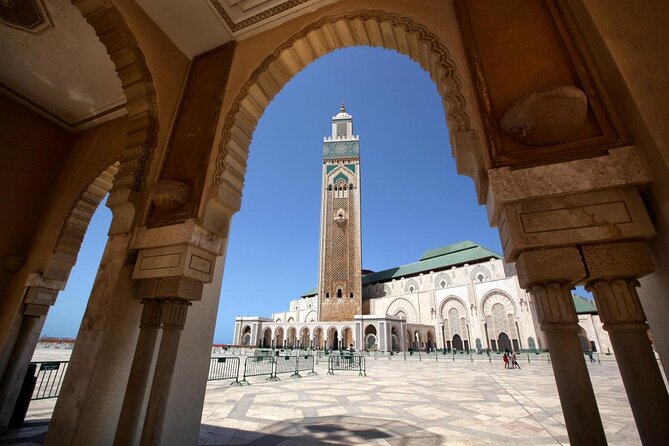
- Hassan II Mosque is the main attraction: Its sea-edge setting, huge prayer hall, zellij decoration, and guided visit make it the clear high point.
- This is a private tour: Only your own group participates, so you can spend more time at the mosque, Habous, or a restaurant if your schedule allows.
- No lunch is included: You receive bottled water, and the guide may help you choose a local meal, but lunch and other drinks cost extra.
- The tour covers more than the movie: Casablanca’s French-era center, Anfa, Ain Diab, the Sacred Heart church, and the United Nations Square add useful city context.
- The vehicle may not feel luxurious: Air conditioning is included, but one report described problems with both heating and cooling, so expectations should remain practical.
The long road from Marrakech to Casablanca
This is not a quick city outing. The advertised duration is about 10 to 12 hours, and one detailed account describes leaving Marrakech at 7:00 a.m. and returning at roughly 7:00 p.m. The drive can take about 2.5 to 3 hours in each direction, leaving a solid block of time for Casablanca itself.
That travel time is the central tradeoff. You lose much of a day on the road, but you gain a look at two very different Moroccan cities. Marrakech is known for its ochre walls, compact medina, and traditional atmosphere. Casablanca is larger, more modern, more commercial, and closely tied to Morocco’s 20th-century development.
I would book this as a focused city introduction, not as a relaxed day at the coast. The private vehicle matters because you can rest between stops instead of dealing with public transport or organizing several separate taxis. Wet wipes and a bottle of water are included, which are small but useful touches on a full day out.
The tour begins at 7:00 a.m. and returns to the meeting point. Pickup is offered, and the activity is private, so your group does not have to share the vehicle or guide with strangers. Group discounts may be available, making the $200 per person price easier to assess for couples or families traveling together.
A few more Marrakech runs to hold up against each other
- Marrakech: Agafay Desert Sunset, Camel Ride, and Dinner Show
★ 4.6 · 35,119 reviews - From Marrakech: Ouzoud Waterfalls Guided Hike and Boat Trip
★ 4.7 · 33,630 reviews - Marrakech: Agafay Desert Quad & Camel Rides with Dinner Show
★ 4.8 · 27,382 reviews
Hassan II Mosque and its ocean setting
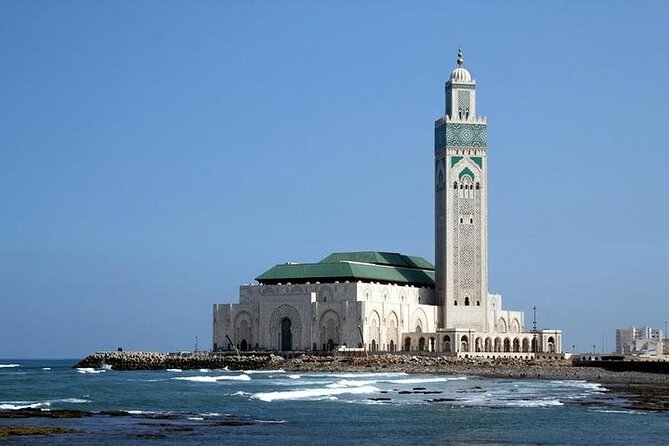
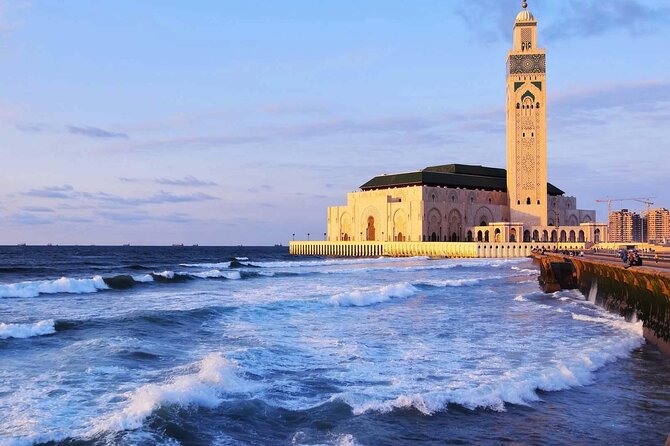
The Hassan II Mosque deserves the most time on this route. Built beside the Atlantic, it was designed around the idea expressed in a Quranic verse that God’s throne was built upon water. The setting gives the building a powerful sense of scale before you even study its details.
The mosque can accommodate about 25,000 worshippers inside and another 80,000 outside. Those figures help explain why this is not just a neighborhood place of worship. It was also intended as a major national monument, one that would give Casablanca a building worthy of its size and importance.
Inside, look for the Moroccan craftsmanship, especially the zellij tilework. Some designs rise more than 10 meters, so take time to look upward and around rather than treating the visit as a quick photo stop. The decoration is large in scale, but it is made from countless small pieces, a contrast that gives the interior much of its appeal.
The planned stop lasts about 50 minutes. The supplied details are inconsistent about the entrance fee: one section says admission is not included, while another lists the right to enter Hassan II Mosque as included. I would confirm this before paying, since a guided interior visit is a major part of the tour’s value.
A guide adds useful context here. Noor is repeatedly praised for clear English, historical explanations, and a calm pace. One account also identifies Moor, described as a Casablanca native, as an excellent guide. Since guide assignments can change, ask who will lead your group and confirm the language you need.
Casablanca’s movie connection in the city center
The movie Casablanca is linked to the city more by name and atmosphere than by actual filming history. The downtown stop brings you to a restored former medina residence known as Madam Rick, an American woman who had lived in Morocco and restored the multi-level home in the style of the film’s era.
The building is centered on an authentic 1930s Pleyel piano. That detail gives the stop a more personal feel than a generic movie sign. You can spend about 10 minutes here, and admission is listed as free.
This is a short visit, so it should not be the reason you book the full day. Still, it adds a bit of playful film culture to a route otherwise focused on architecture, religion, and city history. If you are a serious movie fan, keep your expectations measured. The strongest parts of the Casablanca visit are the mosque and the city itself, not a large collection of film locations.
Ain Diab and the Atlantic Corniche
Ain Diab is Casablanca’s seaside suburb, stretching along the Atlantic with a long promenade called the Corniche. The 30-minute stop lets you see a different side of the city, where the coast, leisure areas, and dense urban development meet.
The value here is visual contrast. Casablanca is not only government offices, apartment blocks, and old markets. At the Corniche, you get open sea views and a sense of how the city uses its waterfront.
Thirty minutes is enough for a look and some photographs, but not enough for a long seaside outing. If you want a slow walk, a beach visit, or extended time by the water, tell your guide early and ask what can be adjusted. The private format gives you more control than a fixed group schedule, but the long journey from Marrakech limits how much extra time you can add.
Same city gate, a very different afternoon:
- Marrakech: Agafay Desert Quad Biking Tour with Dinner-Show
★ 4.8 · 16,569 reviews - Marrakech: Atlas Mountains, Ourika Valley, Waterfall & Lunch
★ 4.8 · 15,834 reviews - From Marrakech: 3-Day Merzouga and Sahara Desert Tour
★ 4.9 · 15,308 reviews - Berber villages : Atlas Mountains Day Hike from Marrakech
★ 5.0 · 14,007 reviews
Anfa, French-era villas, and wartime history
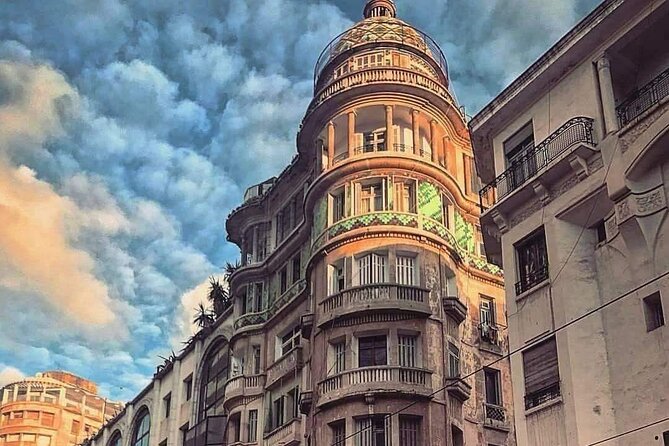
The Anfa district helps explain Casablanca’s modern character. The city grew from the medieval town of Anfa, and during the French protectorate period the seaside area became a place for grand villas built for senior officers and wealthy merchants.
Many of those villas still serve as homes for wealthy Moroccans. You should not expect to enter private residences, but the drive through the district gives you a look at the city’s colonial-era planning and upper-income neighborhoods.
The stop also points to the Anfa Hotel, associated with the 1943 conference involving Winston Churchill and Franklin D. Roosevelt. That meeting took place during the Second World War and included discussions that fixed the date and arrangements for the Normandy landings in June 1944.
The planned visit lasts about 30 minutes. This is primarily a history stop, so its appeal depends on your interest in 20th-century politics and war history. The guide’s storytelling matters here. A rushed drive past buildings will mean less than a clear explanation of why the conference mattered.
Place des Nations Unies and the administrative center
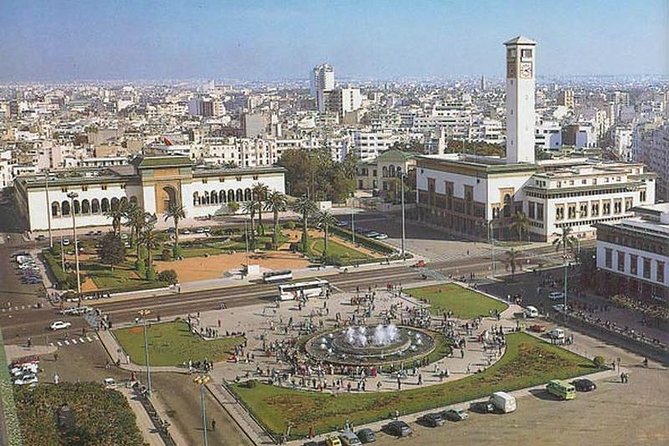
Place des Nations Unies, or United Nations Square, introduces Casablanca’s administrative core. French architects designed several of the surrounding buildings in the 1920s, including the Wilaya, the main government office, with its clock tower.
The courthouse also borders the square, along with a fountain designed for musical and light displays at night. Pigeons gather around the fountain, where visitors offer grain and the birds drink the water. It is a simple urban scene, but it shows how a formal civic center can also function as a public meeting place.
The stop lasts about 30 minutes and is free. I would use this time to listen closely to the guide’s explanation of the buildings rather than expecting a major single attraction. Casablanca’s appeal comes from these layers: traditional Moroccan design, French planning, government architecture, and ordinary city life sharing the same streets.
The Sacred Heart church and its stained glass
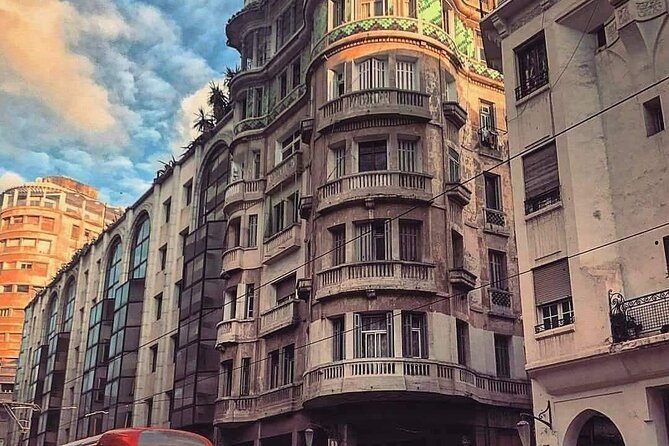
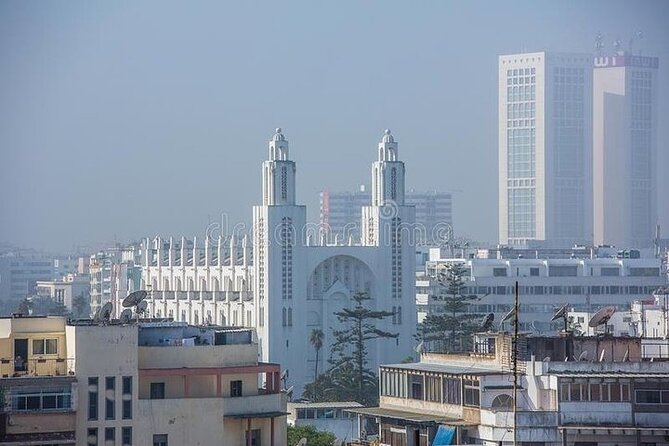
L’Eglise du Sacre-Coeur is a Catholic parish church built in 1954. It is especially used by people of African origin from sub-Saharan Africa, giving the building a continuing role within Casablanca’s international religious community.
The church is decorated with stained-glass windows by Gabriel Loire, a well-known artist. The visit is scheduled for about 30 minutes and admission is free.
This stop adds a useful counterpoint to the mosque. Casablanca’s religious history is not represented by one tradition alone, and the church’s mid-20th-century design adds another layer to the city’s built environment. The attraction may be less important to you if your main goal is Moroccan Islamic architecture, but it is worthwhile for anyone interested in the city’s wider cultural mix.
As with any religious site, the practical experience can depend on opening arrangements and services. The information provided does not give a guaranteed visiting schedule, so confirm the day’s access with the guide.
Habous quarter, souks, and the Royal Palace
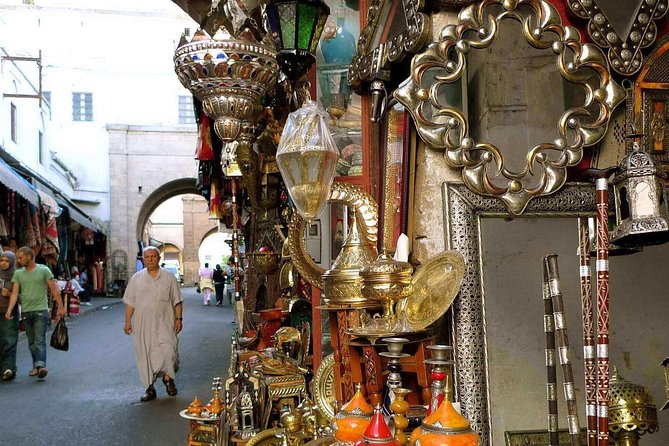
Quartier Habous is often called Casablanca’s New Medina. It was built by the French in the early 20th century but designed to look like a traditional Moroccan medina, with narrow lanes, small tree-lined squares, stone arches, and market streets.
This is one of the most useful stops for shopping and atmosphere. The souks are particularly associated with traditional Moroccan clothing. You may find this easier to navigate than a huge old medina, while still getting the visual experience of arches, alleys, small shops, and local commerce.
The visit is planned for one hour, making it the longest stop after the mosque. That is sensible. Habous rewards a slower pace, especially if you want to browse rather than simply walk through.
The Royal Palace is also in the area. You cannot assume that entry is available, but the exterior is described as one of Casablanca’s finest monuments, combining Arab-Muslim design with modern construction. Ask your guide where the best permitted view is and allow time for the palace area without expecting an interior tour.
If you plan to buy clothing or other goods, compare prices and do not feel pressured to purchase immediately. The private format gives you room to browse, ask questions, and move on when you are ready.
Lunch, local food, and the real cost
Lunch is not included in the $200 price, and drinks are also extra. A complimentary bottle of water is provided for each person, while coffee or tea and a special fruit juice are listed among the included offerings. The wording around these refreshments is not perfectly clear, so confirm what is covered when booking.
The food stop can become one of the day’s most memorable parts if you are open to local recommendations. Noor has taken visitors to a local restaurant for chicken tagine, and another account describes lunch at a popular local market where the food was excellent, despite limited English at the venue.
That is where a local guide can add real value. You may be less likely to try a small market or restaurant when you cannot communicate easily, while a guide can point you toward a suitable choice. Still, you pay for lunch yourself, and the menu, restaurant, and timing may vary.
At $200 per person, this is not a budget day trip. The price makes more sense if you are sharing the private vehicle, want hotel pickup, value a flexible pace, and would otherwise need to arrange transport, a guide, and mosque access separately. It is harder to justify for a solo visitor focused only on the mosque, especially after adding lunch and the long return drive.
Is the vehicle really luxury?
The air-conditioned vehicle is a practical feature, particularly after several hours on the road. Most of the route takes place between stops, so a clean, comfortable vehicle affects your day more than it would on a short walking tour.
The experience is not entirely consistent. One account describes a van with a bad smell and heating and air-conditioning problems, with discomfort on both the cold morning departure and the hot ride back. The response explained that Noor had become ill the night before and could not lead the trip, but that does not remove the practical concern about vehicle standards.
I would contact the provider before booking and ask what vehicle is assigned, how many people it holds, and whether the air conditioning and heating are working. The private format is a strong advantage, but it does not automatically make the transport luxurious.
Who should book this Casablanca day trip?
This tour suits you if you want to see a wide range of Casablanca in one day and prefer having a guide handle the driving and route. It is particularly useful for first-time visitors who want history, architecture, the mosque, a market quarter, and the waterfront without planning every transfer themselves.
It also suits families and small groups. You can control the pace, take breaks, and ask to spend more time at a favorite stop. The accounts praising Noor repeatedly point to his kindness, clear English, early pickup, driving, and willingness to adjust the day.
I would think twice if you dislike long road journeys or want a slow, unhurried visit. The route is packed, and the 10 to 12 hour schedule leaves little room for delays. It is also not the best choice if you expect a polished luxury vehicle as part of the price.
The overall rating is 4.9 from 31 ratings, with 97 percent recommending the experience. Those figures support the tour’s strongest qualities: a good guide, a well-planned city route, and a memorable mosque visit. They do not erase the one serious transport complaint, so ask questions before confirming.
Free cancellation is available up to 24 hours before the start time for a full refund. Changes or cancellations made less than 24 hours before departure are not accepted for a refund, and the local start time controls the cutoff.
Should you book it?
Book this tour if Hassan II Mosque, Casablanca’s architecture, and a private guide are worth a full day away from Marrakech. The mosque, Habous quarter, Corniche, Anfa, and central squares give you a well-rounded first look at the city, while Noor’s reported care and flexibility can make the long schedule easier.
Skip it if you want a leisurely coastal day, dislike several hours in a vehicle, or require guaranteed luxury transport. Before paying, confirm mosque admission, the assigned guide, the vehicle’s heating and cooling, and how lunch will be handled. With those points settled, this is a strong choice for a one-day Casablanca introduction.
FAQ
How long is the Casablanca tour from Marrakech?
The tour lasts approximately 10 to 12 hours. It starts at 7:00 a.m., and one reported schedule returned to Marrakech at about 7:00 p.m.
Is the tour private?
Yes. This is a private activity, and only your group participates.
Is lunch included?
No. Lunch and other drinks are not included. A bottle of water is provided for each person.
Is Hassan II Mosque admission included?
The supplied details conflict. One section says the admission ticket is not included, while another lists entry to Hassan II Mosque as included. Confirm this point with the provider before booking.
Can I cancel for a full refund?
Yes, if you cancel at least 24 hours before the experience begins. Cancellations or changes made less than 24 hours before the start time are not refunded.
Where does the tour end?
The activity ends back at the meeting point.
Just listed around Marrakech
- Zagora: 2-Day Desert Trip from Marrakech★ 4.4 · 31 reviews
- Traditional spa Hammam & Massage with Hotel Transfers★ 4.0 · 24 reviews
- Day trip to OUZOUD waterfall with guide&boat ride from Marrakech★ 5.0 · 172 reviews
- quad bike tour in the palmeraie of Marrakech★ 4.5 · 43 reviews
- Half day quad desert agafay★ 4.5 · 24 reviews
- walking tour★ 5.0 · 46 reviews
- 3 days tour from Marrakech to Merzouga desert★ 5.0 · 55 reviews
- private tour of Marrakech 4 hours with multilingual driver★ 5.0 · 117 reviews
VIP, compared.
Majestic Desert: 3-Day Luxury Journey from Marrakech to Fes
Read our review →
2-Day Merzouga Desert Trip w/Luxury Tent & Dinner
Read our review →
Experience Luxury in Zagora: 2-Day Desert Adventure
Read our review →
3-Day Tour from Marrakech to Merzouga Luxury Camp with Camel
Read our review →
Browse the lists this tour appears in