
Reviewed · CYCLING TOURS
Marrakesh: Toubkal National Park Mountain Bike Trip w/Lunch
Mountain roads, Berber villages, and big views await. This seven-hour trip takes you from Marrakesh to Imlil and into Toubkal National Park, where you ride rough tracks through the High Atlas with a local guide. The route includes high mountain passes, village paths, the Imnane Valley, and a long descent toward Asni.
I especially like the small-group format, limited to 10 people, and the chance to see rural Morocco under your own pedal power. The argan oil cooperative visit and picnic beside the river add local character, while the guide can adjust the pace to suit the group. The main caution is fitness: expect roughly 30 to 36 kilometers of riding and anywhere from 750 to 1,200 meters of climbing, depending on the route and conditions.
The day is also subject to road and group logistics. Pickup times can slip, and a shared minibus may include people booked for other activities. In winter, snow and ice can block the high pass, so the advertised route may change.
In This Review
- Key points to know before booking
- From Marrakesh to Imlil at the foot of Toubkal
- The first climb tests your legs
- Mint tea at 2,300 meters
- Descending through Tachedirt, Tamguist, and Amssakrou
- The Imnane Valley and its farm fields
- Argan oil and the human side of the day
- Lunch beside the river at 1,600 meters
- The final ride to Asni and the return to Marrakesh
- How hard is this mountain bike trip?
- What the $68 price includes
- Practical preparation for the Atlas
- Should you book the Toubkal mountain bike trip?
- FAQ
- How long does the mountain bike trip last?
- What languages does the guide speak?
- Is hotel pickup included?
- What equipment is provided?
- Is lunch included?
- How difficult is the cycling?
- Can the route change in winter?
- How many people are in the group?
Key points to know before booking
- The ride begins in Imlil, not Marrakesh: A short transfer brings you to the foot of Toubkal, Morocco’s highest mountain at 4,167 meters.
- Expect a real mountain ride: The route includes an opening climb, rough single-track, donkey paths, and long descents.
- Views are best around the 2,300-meter pass: Stop here for mint tea, biscuits, and broad views over the Atlas valleys.
- Lunch comes late: The main meal follows the riding, so bring extra food and water for the morning.
- Pickup may be flexible rather than clockwork: Medina collection can happen at Jemaa el Fna, and shared transfers may take longer than planned.
- Winter changes the route: Warm clothes and rain gear are sensible, especially when snow or ice affects the pass.
From Marrakesh to Imlil at the foot of Toubkal
The day starts with hotel pickup in Marrakesh. If your accommodation is inside the medina or on a lane too narrow for a vehicle, you may be asked to meet at Jemaa el Fna, the city’s main square. That is useful to know before you book, since getting to the meeting point with bikes, water, and warm clothing takes a little planning.
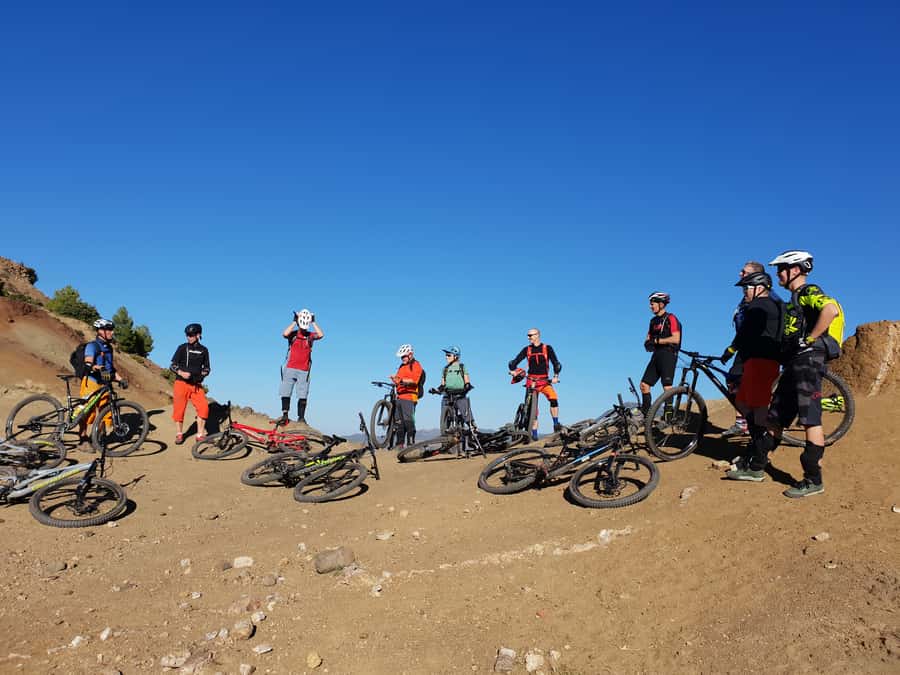
The transfer brings you to Imlil, a mountain village below Toubkal. Here you meet the cycling guide, receive a mountain bike and helmet, and go through a basic safety briefing. The guide explains how the bike works and gives you time to practice before the route begins.
That introduction matters. This is not a flat cycle along a paved road. You will ride gravel, rough off-road tracks, narrow single-track, and paths traditionally used by donkeys. A patient guide can make a major difference, especially when the surface becomes loose or the gradient changes quickly.
The stated languages are Arabic, English, and French. The group is capped at 10 people, though the actual day can feel smaller or larger depending on the number of cyclists and the shared transport arrangements.
A few more Marrakech runs to hold up against each other
- Cycling Adventure in Marrakech
★ 5.0 · 289 reviews - Dutch Bike Tour in Marrakech with Local Guide
★ 4.7 · 269 reviews - Marrakech:Guided City Cycling Tour – Culture, Colors & Charm
★ 4.7 · 231 reviews
The first climb tests your legs
The ride begins with a climb. It is described as manageable rather than brutal, but it still puts pressure on the pedals and gives the guide a chance to check that the bikes are working properly. This is the point to speak up about saddle height, brakes, gears, or any discomfort.
The total climbing reported for the route ranges widely. One ride covered about 750 meters of ascent, while another reached roughly 900 to 1,000 meters, and one longer account recorded 1,200 meters. That difference may reflect the exact route, the group’s pace, or changes caused by weather and trail conditions.
You decide the pace and speed, which is good news if your group has mixed ability. Still, do not confuse a flexible pace with an easy outing. You need reasonable cycling fitness and comfort on uneven ground. The hardest part may not be the distance itself, but repeated climbing on rough surfaces.
If you are used to road cycling, allow time to adapt to loose gravel and single-track. If you have mountain biking experience, you will get more from the descents and technical sections. One account also refers to an e-bike making the climbing easier, but the standard inclusion is a mountain bike, so confirm the equipment available when booking if electric assistance matters to you.
Mint tea at 2,300 meters
The high point of the route is around 2,300 meters, at coordinates given for the pass as 31°08’53.45 N, 7°53’18.42 W. The exact numbers are less important than what they tell you: this is a genuinely high mountain ride, not simply a countryside cycle near Marrakesh.
The usual pause includes mint tea and biscuits. Take it. It gives you time to catch your breath, enjoy the views, and check your bike before the long descent. It also breaks up the day in a pleasant Moroccan way, with tea replacing the rushed snack stop common on many active excursions.
From the pass, the scenery opens across jagged mountain slopes and deep valleys. You may see small villages scattered along the route, along with fields of vegetables and cereals in the Imnane Valley. The views are a major reason to choose this trip, but remember that weather can affect them. Winter snow and ice have prevented riders from reaching the pass or crossing to the other side.
Descending through Tachedirt, Tamguist, and Amssakrou
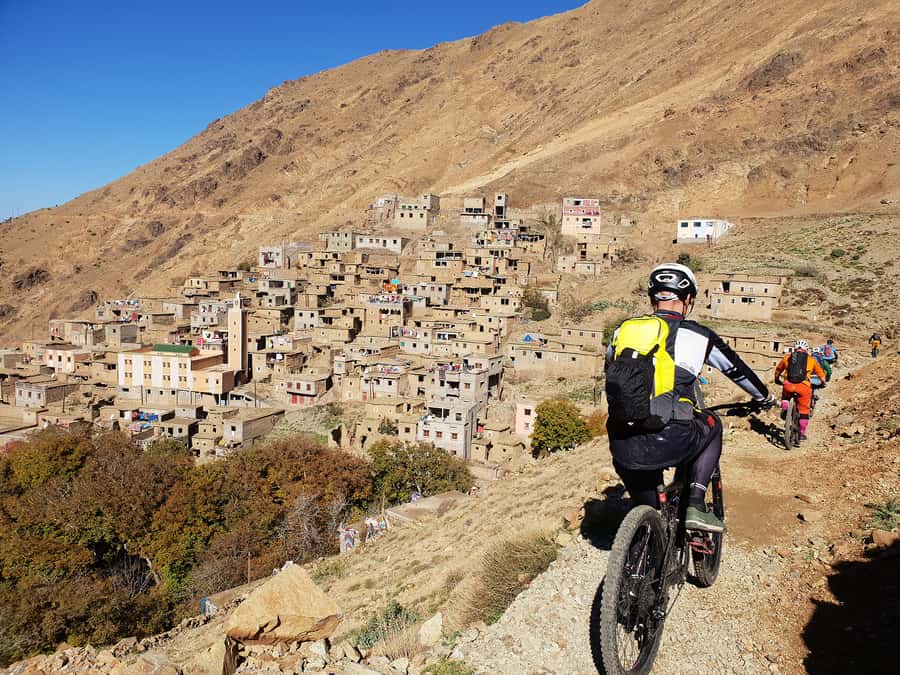
The ride then turns toward a series of Berber villages, including Tachedirt, Tamguist, and Amssakrou. This is the part that gives the trip its strongest sense of place. Instead of viewing the Atlas from a roadside lookout, you pass through working villages and mountain paths at cycling speed.
The route includes fast gravel descents and donkey tracks. That combination sounds exciting, and it is, but it also calls for care. Loose surfaces can make braking and cornering less predictable. Your guide’s job is not only to show the way but also to point out hazards, help with bike handling, and keep the group together.
You control your own speed. If a descent feels too fast, slow down. The guide can assist, but you remain responsible for riding within your ability. A helmet is included, and wearing it is essential on this kind of surface.
The guide also shares information about Berber life, local plants, and the national park. The value here is not a long formal lecture. It is the small explanations along the path: why a village sits where it does, what grows in the valley, or how people use the mountain routes today.
Same city gate, a very different afternoon:
- Marrakech: Agafay Desert Sunset, Camel Ride, and Dinner Show
★ 4.6 · 35,119 reviews - From Marrakech: Ouzoud Waterfalls Guided Hike and Boat Trip
★ 4.7 · 33,630 reviews - Marrakech: Agafay Desert Quad & Camel Rides with Dinner Show
★ 4.8 · 27,382 reviews - Marrakech: Agafay Desert Quad Biking Tour with Dinner-Show
★ 4.8 · 16,569 reviews
The Imnane Valley and its farm fields
After the villages, the route follows the Imnane Valley downward for several hours, often on single-track. This extended descent is one of the strongest parts of the day for confident mountain bikers. You get changing views, rough trail, and a sense of moving through the valley rather than simply stopping at scenic points.
You also get a closer look at cultivated Morocco. Green fields of vegetables and cereals contrast with the dry, rugged slopes above them. The valley shows how farming communities make use of narrow strips of workable land in a high mountain setting.
The trip pauses at scenic points for photographs, so bring a camera or phone, but protect it from dust and accidental drops. The ride is active enough that you will not want to stop constantly. The best approach is to enjoy the route first and use the planned pauses for pictures.
This is also where group differences can become noticeable. Strong riders may want to continue, while less confident cyclists may need more time. Since the guide puts safety first and allows the group to choose its pace, communication helps. Tell the guide early if you need a slower descent or a short rest.
Argan oil and the human side of the day
The trip includes a stop at an argan oil cooperative. You can see women hand-cracking argan nuts, a simple detail that gives context to a product often sold in Marrakesh shops without much explanation.
This stop is one of the more commercial parts of the outing, but it can still be worthwhile if you treat it as a chance to understand the work behind the oil. It also breaks up the transfer and connects the mountain day with a familiar Moroccan product.
Timing can vary. One account describes an argan cooperative stop and breakfast before the ride, with cycling not beginning until around noon. The main description places the cooperative among the day’s highlights but does not promise a fixed time. If you are hoping for an early morning ride, ask for the actual pickup and cycling schedule before departure.
Lunch beside the river at 1,600 meters
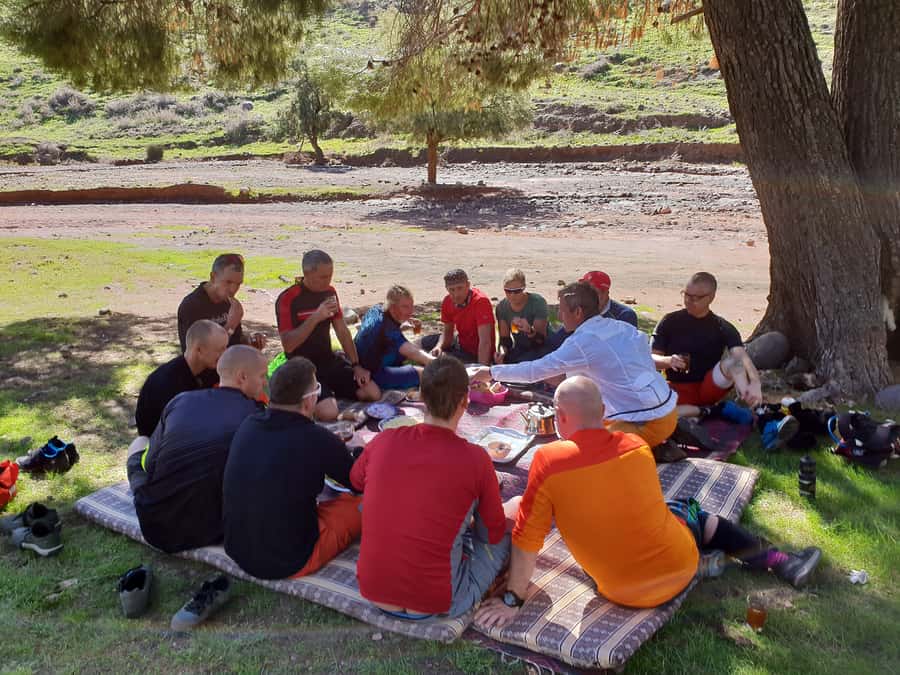
Lunch follows the main riding, after the route drops into the riverbed. The planned meal is a picnic beside the river at about 1,600 meters. It is meant to be a long, relaxed break after the climb and descent.
This timing deserves attention. You may not eat a proper meal until after the cycling, so bring your own snack and enough water. One account specifically advises carrying extra food and drinks because lunch comes late. Soft drinks are not included, so budget for those separately or bring your own if permitted.
The exact lunch setting may change. One account describes eating on a rooftop with views toward the Atlas rather than beside the river. That suggests the provider may adjust the meal location according to the route, weather, or day’s schedule. Either way, lunch is included, but you should not expect a fixed restaurant experience.
A picnic also suits the character of the day. After several hours on the trail, a slow meal outdoors feels more fitting than a quick stop in a busy café. Just do not mistake the word picnic for a light snack. It is the included lunch, and it comes after the main effort.
The final ride to Asni and the return to Marrakesh
After lunch, the route continues for a shorter ride toward Asni. The driver meets the group there, and the minibus takes you back to Marrakesh.
The return can be long. Shared vehicles may collect or drop off people booked on other activities, and a late finish is possible. One account describes several extra stops, including a camel-riding group, and a return to Marrakesh just before 6 p.m. Another reports repeated loops around the medina while other passengers were dropped off.
That is not a problem if you regard this as a full day rather than a precise seven-hour appointment. It becomes frustrating if you have a dinner reservation, airport transfer, or evening show. Leave your evening open.
Pickup and drop-off are included, which adds real value at this price. You do not need to arrange a separate driver to reach Imlil or Asni. The tradeoff is that shared transport may include several different itineraries.
How hard is this mountain bike trip?
I would rate it as active and challenging, not suitable for a complete beginner unless you are comfortable with sustained climbing and rough trails. The distance, elevation gain, and loose descents require basic fitness and some bike control.
You do not need to race. The guide helps you use the bike properly, and the pace is set with the group in mind. But you should be able to pedal uphill for a significant stretch and remain comfortable on gravel and uneven tracks.
This trip suits you best if you:
- Ride a bicycle regularly
- Enjoy hills and off-road surfaces
- Want views and village contact rather than a city sightseeing day
- Are comfortable with a late lunch
- Can accept changes caused by snow, ice, traffic, or group transfers
It is less suitable if you want a gentle ride, a guaranteed summit crossing, or a tightly timed itinerary. Families and first-time cyclists should ask about the route and bike options before paying.
What the $68 price includes
At $68 per person, the tour offers strong value for an active day in the High Atlas. The price includes hotel pickup and drop-off, the mountain bike, helmet, official guide, and lunch. A private transfer to Imlil alone would add to the cost, so the included transport is important.
The guide is the heart of the value. You receive route support, safety guidance, local explanations, and help with the bike. The day also combines several experiences that would be difficult to arrange independently: Imlil, a mountain pass, Berber villages, Imnane Valley, an argan cooperative, lunch, and the transfer to Asni.
The compromises are clear. This is a shared trip, the schedule may drift, and soft drinks are extra. Also, the exact distance and elevation can vary. At this price, I think that is a fair trade for travelers who care more about the ride and scenery than polished transport.
Free cancellation up to 24 hours before departure and reserve-now, pay-later booking make it easier to keep plans flexible. Those policies are useful in winter, when weather may have a greater effect on the route.
Practical preparation for the Atlas
Bring sunscreen and personal medication. The sun can feel strong at altitude even when the air is cool.
Carry extra water and a snack because lunch comes after the ride. Soft drinks are not included. Wear clothing that works across changing conditions, and bring warm layers and rain gear in winter.
Do not rely on Marrakesh’s warm weather as a guide to the mountains. Snow and ice can appear on the high route, and the pass may not be reachable. Comfortable cycling clothes, sturdy shoes, and gloves would be sensible, although only the helmet and bike are specifically listed as included equipment.
If pickup is from Jemaa el Fna, arrive with time to spare. Confirm the meeting point and expected departure time, especially if you are staying in the medina.
Should you book the Toubkal mountain bike trip?
Book it if you want a physically active day with broad Atlas views, rural villages, and long off-road descents. The scenery, friendly local guiding, and small group make this more rewarding than a simple drive into the mountains.
Skip it if your main goal is relaxation, a guaranteed early start, or a carefully controlled timetable. You should also think twice if you have little cycling experience or dislike rough tracks.
For the right rider, $68 is a good deal. Bring food, water, warm layers, and patience for the transport. If you do, this can be one of the more memorable ways to experience the High Atlas from Marrakesh.
FAQ
How long does the mountain bike trip last?
The stated duration is seven hours, including the transfer, cycling, lunch, and return arrangements. The day can run longer if pickup or shared drop-offs are delayed.
What languages does the guide speak?
Guides are available in Arabic, English, and French.
Is hotel pickup included?
Yes. Hotel pickup and drop-off are included. If your hotel is inside the medina or inaccessible by car, you may be asked to meet at Jemaa el Fna.
What equipment is provided?
A mountain bike and helmet are included. The activity also includes an official guide.
Is lunch included?
Yes. Lunch is included and is described as a picnic beside the river at about 1,600 meters. The meal location can vary, and soft drinks are not included.
How difficult is the cycling?
The route is described as challenging, with an opening climb, rough off-road tracks, single-track, and substantial elevation gain. Recorded rides range from about 750 to 1,200 meters of climbing.
Can the route change in winter?
Yes. Snow and ice can prevent the group from reaching the high pass or continuing to the other side. Warm clothes and rain gear are recommended during winter.
How many people are in the group?
The activity is offered as a small-group tour with up to 10 participants.
More Days That Include Lunch in Marrakech
- Marrakech: Atlas Mountains, Ourika Valley, Waterfall & Lunch
★ 4.8 · 15,834 reviews - Marrakesh: Ourika Waterfalls, Atlas Mountains, Guide + Lunch
★ 4.9 · 9,986 reviews - Marrakesh: Desert & Mountain Tour with Camel Ride & Lunch
★ 4.8 · 7,513 reviews - From Marrakech: Atlas Mountains Full-Day Hiking Trip w Lunch
★ 4.8 · 7,417 reviews
Just listed around Marrakech
- 3 Days To Merzouga Desert★ 5.0 · 19 reviews
- 3 Days Shared Sahara Desert Tour From Marrakech★ 5.0 · 78 reviews
- 1 night Camel Treking in Merzouga Desert Luxury Camp★ 5.0 · 132 reviews
- 3 Days Sahara Desert Trips From Marrakesh★ 5.0 · 176 reviews
- 3 Days Sahara Tour from Marrakech to Merzouga Dunes★ 5.0 · 29 reviews
- trip of your dreams in 3 days and 2 nights in the desert★ 5.0 · 36 reviews
- 3 Days Private Tour to Merzouga Desert from Marrakech★ 5.0 · 77 reviews
- 3 Days Merzouga Sahara Tour & Camel Trek★ 5.0 · 54 reviews
Cycling Tours, compared.
Guided City Cycling Tour – Culture, Colors & Charm
Read our review →
Cycling Tour in Palm Groove with Local Breakfast
Read our review →
Guided Cycling Adventure in Casablanca with Licensed Tour Guide
Read our review →
Agafay tour Quade Bike, Sunset and Romantic Dinner Show
Read our review →Browse the lists this tour appears in