
Reviewed · SAHARA DESERT TOURS
Sahara desert tour to Merzouga – 3 Days from Marrakech
The road to the Sahara is the adventure. This three-day journey links Marrakech and Merzouga by way of the High Atlas, old kasbahs, dramatic gorges, rose country, and the dunes of Erg Chebbi. I like the strong mix of scenery and culture, and I like that the tour includes the camel trek, desert camp, transport, breakfast, and dinner in one price.
The main caution is the amount of time spent in the vehicle. The route covers a huge stretch of Morocco, and the return to Marrakech is another long day on the road. If you want to reach the Sahara in only three days, this is a practical way to do it, but it is not a slow, restful holiday.
In This Review
- Key points to know before booking
- What the three days are really like
- Day one: Tizi n’Tichka, Ait Benhaddou, and Dades Valley
- Day two: Todra Gorge and the dunes of Erg Chebbi
- Day three: Sunrise, camels, and the long return to Marrakech
- Why the changing scenery is worth the road time
- Transport, group size, and comfort
- Food and overnight stays
- Is $406.51 good value?
- Who should book this Merzouga tour?
- Booking details worth checking
- Should you book it?
- FAQ
- How long is the Sahara tour from Marrakech to Merzouga?
- What time does the tour start?
- Where does the tour end?
- What places are visited on the route?
- Is a camel ride included?
- Where do you sleep during the tour?
- Are meals included?
- How many people can join the tour?
Key points to know before booking
- You cross the Tizi n’Tichka Pass twice: The High Atlas drive brings mountain villages, sharp bends, and wide views before the road drops toward the desert.
- Ait Benhaddou is part of the route: This famous kasbah village adds a major cultural stop to the first day.
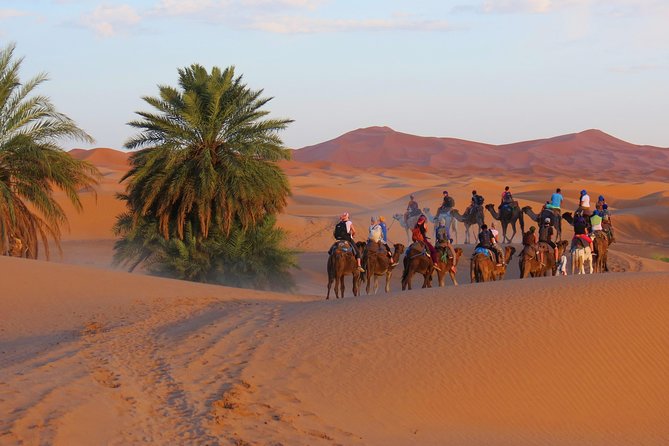
- The Sahara night is the centerpiece: You ride one camel per person into Erg Chebbi, watch sunset, eat dinner, and sleep in a Berber tent.
- The group is limited to 17 people: That is smaller and more personal than a large coach tour, though the exact feel depends on the vehicle and final group size.
- Meals are only partly covered: Breakfast and dinner are included, while lunches and drinks are extra.
- The driver can shape the experience: Past guests singled out drivers including Ibrahim, Hisham, Jamal, Nouri, Radwan, Omar, Mohammed, Mostapha, Younes, and Abdul Gal for safe driving, useful stops, and friendly local insight.
What the three days are really like
This tour is best understood as a fast crossing of southern Morocco, not simply a ride to a camp in the dunes. You begin in Marrakech and move through several different parts of the country in a short time.
The route gives you mountain scenery, oasis towns, kasbahs, narrow gorges, and desert sand. That variety is the reason to choose it. The tradeoff is that each day packs in a lot of road time, so you should arrive rested and ready for long stretches in an air-conditioned vehicle.
The tour starts at 8:00 a.m. from Jemaa el-Fna in central Marrakech, with hotel pickup and drop-off service included. The stated maximum is 17 people, and a professional driver-guide handles the route.
More Sahara nights out of Marrakech:
- From Marrakech: 3-Day Merzouga and Sahara Desert Tour
★ 4.9 · 15,308 reviews - From Marrakech: Merzouga 3-Day Desert Safari with Food
★ 4.7 · 12,232 reviews - 3 Days Desert Tour From Marrakech To Merzouga Dunes & Camel Trek
★ 5.0 · 10,125 reviews
Day one: Tizi n’Tichka, Ait Benhaddou, and Dades Valley
The first morning takes you south over the Tizi n’Tichka Pass, the major road across the High Atlas Mountains. This is one of the most scenic sections of the trip. You pass through Berber villages and watch the scenery change from the busy Marrakech area to high mountain country.
The road is winding, and the crossing can take time. You should not expect a quick highway run. The reward is the changing view: mountain slopes, exposed rock, small settlements, and the sense that you are leaving the red city far behind.
The tour then continues toward Ait Benhaddou. This fortified village, built from earthen-colored walls, is one of the most recognizable sights on the route between Marrakech and the desert. Its clustered buildings and defensive form show how settlements in this dry region were once organized.
Ait Benhaddou is more than a photo stop. It gives you a useful introduction to southern Morocco’s kasbah architecture and to the way homes, storage areas, and communal spaces were shaped around a harsh climate. Entrance fees are not included, so check with your guide about any optional admission before you enter.
After lunch, the road continues toward the Valley of the Roses and the Dades Valley. The route moves through riverside oases and dry hillsides dotted with kasbahs. That contrast is one of the pleasures of the day: a strip of green vegetation beside land that otherwise looks almost bare.
The Dades Valley is sometimes called the Valley of a Thousand Kasbahs. The name captures the feel of the route, even if you should not expect to count a thousand buildings from the car window. You will see old earthen structures, palms, fields, and villages spread along the valley.
The first night is spent in Dades. Accommodation is included, but the exact property and room standard are not specified in the tour details. Past descriptions point to a comfortable guesthouse or hotel-style stay, with dinner and breakfast provided.
This day can feel full by the time you arrive. If you want to take photographs, sit near a window and keep your camera ready. The most appealing views often arrive between the named stops.
Day two: Todra Gorge and the dunes of Erg Chebbi
After breakfast, you head toward Todra Gorge. The gorge is one of Morocco’s best-known natural sights, with steep rock walls closing in around the road and valley. The planned stop is short, so think of it as a chance to stretch your legs, take in the scale of the cliffs, and photograph the canyon rather than as a long walking visit.
That short stop is also one of the limitations of a three-day schedule. Todra Gorge deserves more time if you enjoy hiking or geology, but this itinerary must keep moving toward Merzouga. You will see the essential setting, then return to the vehicle for the long drive east.
The road to Erg Chebbi crosses increasingly dry country. By late afternoon, the dunes begin to take over. Arrival is planned for around 4:00 p.m., followed by a short break before the camel ride.
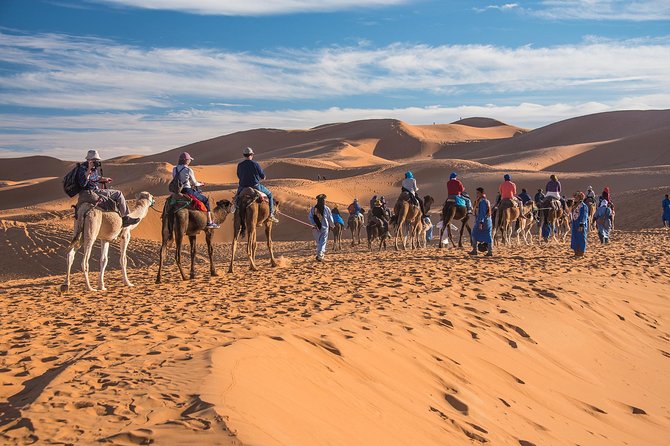
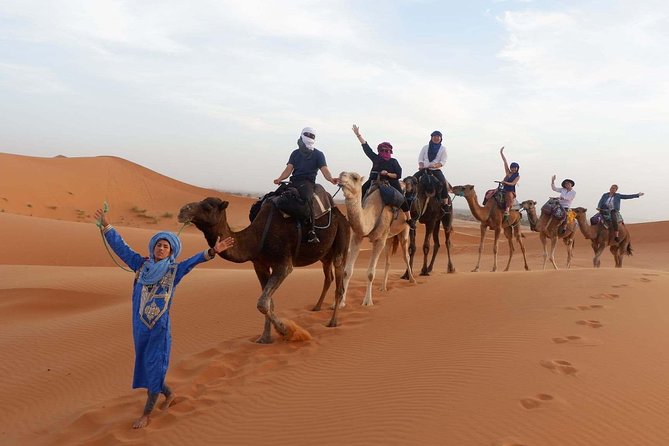
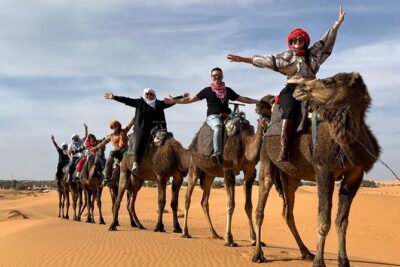
The camel trek is one camel per person. The ride takes you into the dunes, where you watch the sun drop over the sand before continuing to the desert camp. The stated details do not give an exact riding time, but past accounts describe the camel portion as about an hour.
A camel ride is not a luxury transfer. You sit high above the sand, sway with the animal’s pace, and may feel the strain in your legs after a while. Still, it gives you a memorable way to reach camp and makes the desert evening feel like a real journey rather than a simple arrival by vehicle.
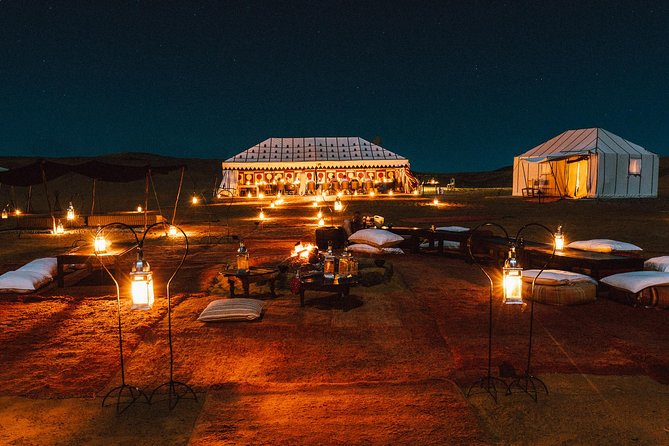
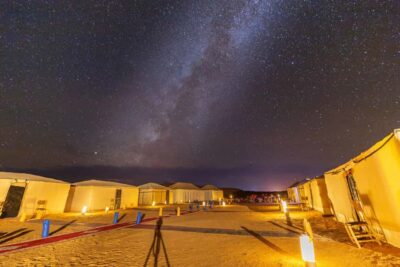
At camp, you sleep in a Berber tent and eat dinner. The setting is the star: broad sand dunes, fading light, and a clear night sky when conditions allow. One guest described the stars as especially striking, and that is easy to understand. Away from city lights, even a simple camp can feel wonderfully removed from ordinary life.
The accommodation is described as a desert camp, but the word camp can cover different standards. Do not assume that every tent has the same facilities as a hotel room. The tour does not specify private bathrooms, electricity arrangements, heating, or the exact level of comfort.
Dinner and breakfast are included. Lunch and drinks are not, so carry enough water for the driving and camel ride, while keeping some cash available for meals and drinks along the way.
Day three: Sunrise, camels, and the long return to Marrakech
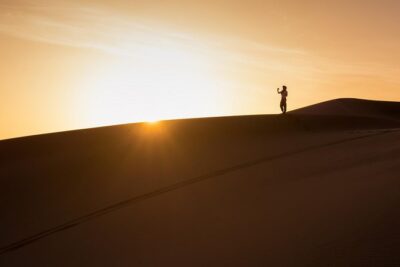
The third morning begins with sunrise at the camp. This is one of the strongest moments of the trip. The dunes take on changing shades as the sun rises, and the quiet gives you a final chance to enjoy the desert before the return journey.
After breakfast, you ride the camels back to the auberge, where the vehicle is waiting. From there, you make the long drive to Marrakech, again crossing the Tizi n’Tichka Pass.
This return day is the toughest part of the itinerary for many people. You have already spent two active days on the road, and the final drive covers much of the distance back in a single day. The itinerary calls it a long day, and you should take that seriously.
A good driver matters here. Past guests repeatedly praised drivers for steady driving, timely pickup, frequent stops, and help finding pleasant places for lunch or tea. Ibrahim, Hisham, Jamal, Nouri, and Radwan received especially warm comments, while Ait Ouaguerd Lahcen was praised for showing up on time and driving calmly.
You should still treat the named drivers as examples, not a guarantee of who will be assigned to you. Ask for your driver’s name and contact details when your pickup is confirmed. A strong driver-guide can make the long road sections far more enjoyable by explaining the regions, suggesting sensible stops, and helping with small practical needs.
A few more Marrakech runs to hold up against each other
- 3-Day Marrakech to Merzouga Desert Tour: Camel Rides & Overnights
★ 5.0 · 8,734 reviews - 3-Day Marrakech to Fes Sahara Desert Tour via Merzouga
★ 5.0 · 6,546 reviews - Marrakech: 3-Day Merzouga Desert Experience Camel & Meals
★ 4.6 · 6,252 reviews - From Marrakech: Unforgettable 3-Day Desert Tour to Fes
★ 4.9 · 2,614 reviews
Why the changing scenery is worth the road time
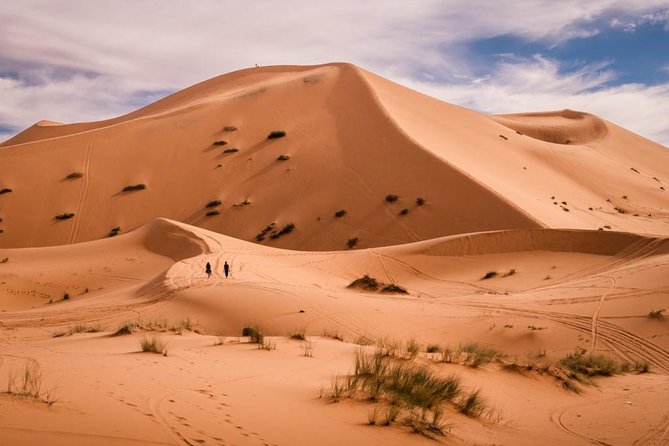
The best feature of this tour is the range of scenery packed into three days. You move from the High Atlas to valleys, kasbah country, cliffs, and sand dunes without needing to arrange several separate transfers.
The Atlas crossing shows you mountain Morocco. The Dades and Todra sections reveal how water supports life in an otherwise dry region. Ait Benhaddou gives the route an architectural and cultural focus, while Erg Chebbi provides the dramatic finish.
I also like that the route is not limited to a single desert photo opportunity. You spend the night near the dunes, see sunset and sunrise, and travel by camel in both directions. That gives you more time to feel the setting than a quick afternoon excursion would.
The cultural side depends heavily on your driver. Some guides have offered background on Berber life, local towns, and Moroccan customs, while others have helped arrange stops at viewpoints, cafés, and roadside places for mint tea or coffee. If you want more than scenery, tell your driver early that you would like explanations and time for questions.
Transport, group size, and comfort
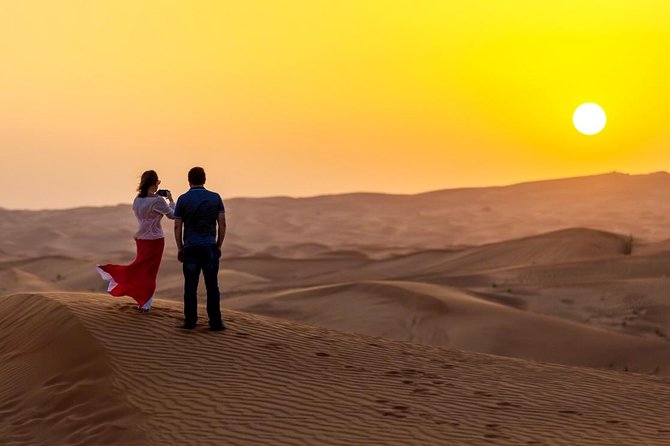
The tour uses an air-conditioned vehicle and includes pickup and drop-off service. The maximum group size is 17, which keeps the operation smaller than a large bus excursion, but it does not guarantee a private tour.
Several of the most enthusiastic accounts describe private tours, including trips booked for couples and families. That is important because private-tour flexibility should not be assumed from this group itinerary. If you want to control every stop, travel only with your own party, or set a slower pace, confirm the booking type before paying.
For the group option, the smaller maximum is still useful. You are less likely to feel lost in a crowd, and the driver can usually communicate more directly with the group. The exact amount of legroom and luggage space depends on the vehicle assigned.
Pack lightly and keep essentials close during the road sections. Useful items include a refillable water bottle, sun protection, a light layer for the desert night, comfortable trousers for the camel ride, and shoes that work on sand and uneven ground.
Food and overnight stays
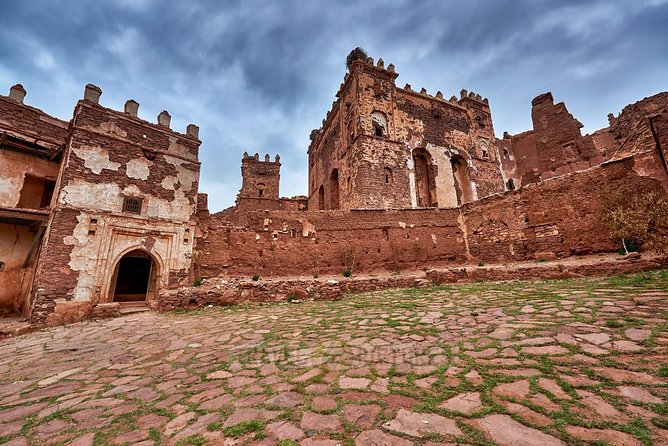
The price includes half-board accommodation, meaning breakfast and dinner are provided. Your first night is in Dades, and your second night is in the desert camp.
Lunches and drinks are extra. That sounds minor, but it matters on a road trip with several long driving periods. Budget for three lunches, drinks, and any café stops. Entrance fees for optional sights are also excluded, as are tips.
Past accounts describe the meals as simple and tasty rather than elaborate. That fits the nature of the journey. You are moving through remote areas, not dining in a city restaurant every evening.
The Dades stay gives you a bed and a chance to recharge before the desert. The camp offers the more memorable setting, but usually with less predictable comfort. I would choose this tour for atmosphere and access, not for luxury accommodation.
Is $406.51 good value?
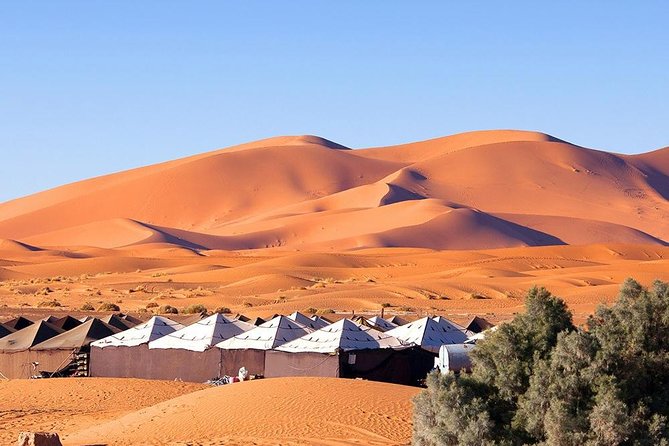
At $406.51 per person, the tour is not the cheapest way to see the Sahara, but it includes several costly and complicated parts of the trip: private road transport within a group of up to 17, a driver-guide, two nights of accommodation, two breakfasts, two dinners, and the camel trek.
The value is strongest if you want one booking to handle the entire route. You do not need to work out how to cross the Atlas, reach Dades, continue to Merzouga, arrange a desert camp, or find your way back to Marrakech.
The value is weaker if you dislike long drives or want plenty of time at each sight. A longer four-day trip would likely make the route less tiring, though that is not the itinerary being reviewed here. You are paying for access and convenience, with speed as the main compromise.
Group discounts may improve the price for larger parties. Since the tour has a maximum of 17 but does not promise a private vehicle, ask exactly how the discount works and what kind of transport your party will share.
Who should book this Merzouga tour?
I would recommend it to you if:
- You have only three days available from Marrakech.
- You want mountains, kasbahs, gorges, and desert in one trip.
- You are comfortable with long road days.
- You want a camel ride and overnight desert camp without arranging the details yourself.
- You value a driver who can add local context and manage the route.
- You are happy with practical accommodation and included dinner and breakfast.
I would think twice if you want slow travel, long hikes, luxury rooms, or complete control over the schedule. Todra Gorge receives only a short stop, and the final return to Marrakech is especially demanding.
The tour suits couples, families, and small groups, but ask if you are booking the group version or a private variation. A family of five, for example, can benefit from a private arrangement, while solo visitors may appreciate the chance to share the road with a smaller group.
Booking details worth checking
Pickup begins at 8:00 a.m. from Jemaa el-Fna, and the activity ends back at the same meeting point in Marrakech. Hotel pickup and drop-off service is included, but you should provide clear accommodation details when arranging pickup.
Confirmation is provided when you book. Most people can take part, though the camel ride and long drives require reasonable comfort with sitting and moving around for extended periods.
The cancellation rule is simple: cancel at least 24 hours before the local start time for a full refund. Cancellations or changes made inside that 24-hour window are not refunded or accepted.
Should you book it?
Book this Sahara tour if reaching Merzouga in three days matters more to you than taking the scenic route slowly. You get a powerful slice of southern Morocco: the Atlas Mountains, Ait Benhaddou, the Dades and Todra areas, and a real night beside the Erg Chebbi dunes.
My advice is to confirm the group or private format, ask who your driver will be, and budget separately for lunches, drinks, optional entry fees, and tips. If you can accept the long return drive, this is a well-packed and good-value introduction to the Moroccan desert.
FAQ
How long is the Sahara tour from Marrakech to Merzouga?
The tour lasts approximately three days, beginning and ending in Marrakech.
What time does the tour start?
Pickup starts at 8:00 a.m. from Jemaa el-Fna in Marrakech.
Where does the tour end?
The activity ends back at the Marrakech meeting point.
What places are visited on the route?
The route includes the Tizi n’Tichka Pass, Berber villages, Ait Benhaddou, the Valley of the Roses, the Dades Valley, Todra Gorge, and the Erg Chebbi dunes near Merzouga.
Is a camel ride included?
Yes. One camel per person is included, with a ride into the dunes and a return ride to the auberge the next morning.
Where do you sleep during the tour?
The first night is spent in Dades. The second night is spent in an overnight desert camp in a Berber tent.
Are meals included?
Breakfast and dinner are included. Lunches and drinks are not included.
How many people can join the tour?
The maximum group size is 17 people. A private tour option may be available, but you should confirm the booking format before purchase.
Just listed around Marrakech
- Zagora: 2-Day Desert Trip from Marrakech★ 4.4 · 31 reviews
- Traditional spa Hammam & Massage with Hotel Transfers★ 4.0 · 24 reviews
- Day trip to OUZOUD waterfall with guide&boat ride from Marrakech★ 5.0 · 172 reviews
- quad bike tour in the palmeraie of Marrakech★ 4.5 · 43 reviews
- Half day quad desert agafay★ 4.5 · 24 reviews
- walking tour★ 5.0 · 46 reviews
- private tour of Marrakech 4 hours with multilingual driver★ 5.0 · 117 reviews
- 3 days tour from Marrakech to Merzouga desert★ 5.0 · 55 reviews
Sahara Desert Tours, compared.
3 Days Desert Tour From Marrakech To Merzouga Dunes & Camel Trek
Read our review →
3-Day Marrakech to Merzouga Desert Tour: Camel Rides & Overnights
Read our review →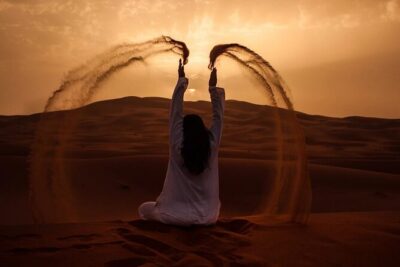
3-Day Marrakech to Fes Sahara Desert Tour via Merzouga
Read our review →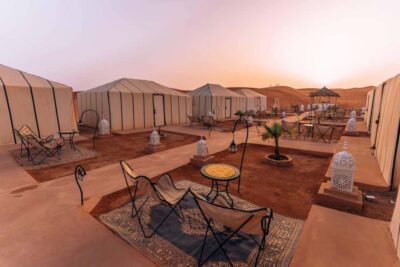
3-Day Merzouga Desert Experience Camel & Meals
Read our review →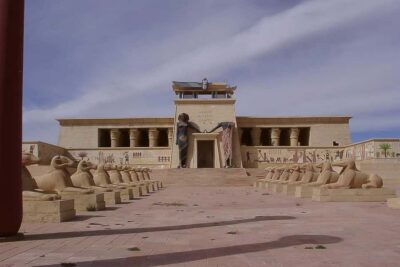
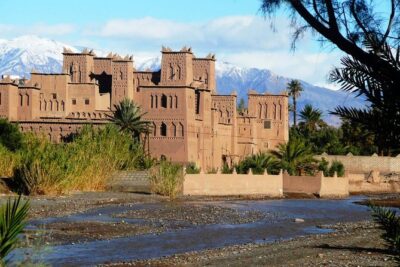
3-Day Tour to Merzouga Erg Chebbi with Food & Camel Trek
Read our review →Browse the lists this tour appears in