
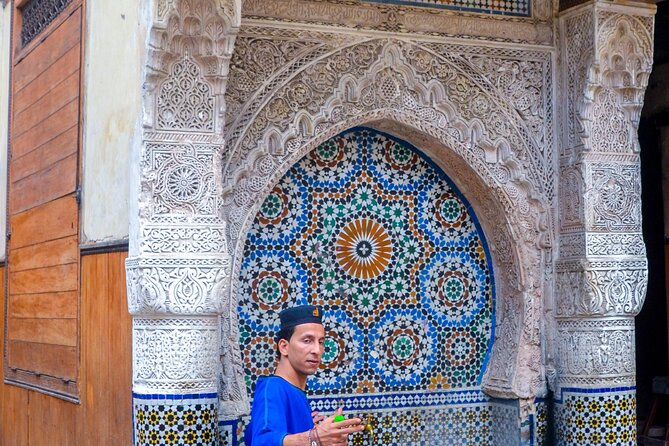
Reviewed · CITY TOURS
Tour guide in the old city of Fez
Fez rewards curious walkers. This two-hour tour with Rachid focuses on the old city’s narrow lanes, historic religious buildings, markets, artisans, and daily life. I like the chance to see places such as the Chouara Tannery and Al-Attarine Madrasa with local explanation, and I also like the tour’s small maximum of 10 people, which should make it easier to ask questions and keep together in the medina.
The price is reasonable at $29.08 per person, especially if Rachid provides the promised context and helps you make sense of Fez el-Bali. I also appreciate the stated focus on supporting local businesses and traditional crafts. The main caution is that this is a fast-moving walking route with many brief stops, and one serious complaint describes a visitor being left in the medina without clear guidance. The provider’s response says the money was refunded and that the problem arose from circumstances outside the guide’s control.
In This Review
- Key points before you book
- Why a guided walk helps in Fez el-Bali
- Kairaouine Mosque and the center of learning
- Sidi Ahmed Al-Tijani Zawiya
- The Royal Palace gates in Fez
- Al-Attarine Madrasa and Marinid design
- Bab Boujloud, Fez’s blue gateway
- One hour inside Fes el-Bali
- Souk Attarine and Fez’s traditional trades
- Dar Batha Museum and royal collections
- Chouara Tannery and the smell of leather
- Moulay Idriss II Mausoleum from outside
- Is $29.08 a fair price?
- A note about reliability and meeting arrangements
- Who should choose this Fez walking tour?
- Should you book Rachid’s Fez medina tour?
- FAQ
- Where does this walking tour take place?
- How long does the tour last?
- Who guides the experience?
- How many people can join the tour?
- Is transportation included?
- Is the tour suitable for most people?
- Can foreign visitors enter the Royal Palace?
- Can foreign visitors enter the Moulay Idriss II Mausoleum?
- Is admission to Al-Attarine Madrasa included?
- What is the cancellation policy?
Key points before you book
- Rachid leads the walk: You get a named local guide rather than a large anonymous group.
- Ten stops in about two hours: Expect an overview of Fez, not a slow visit to every monument.
- Chouara Tannery is included: This is one of the tour’s most memorable sights, with old leather-making traditions still visible.
- Several sites are viewed from outside: The Royal Palace grounds and Moulay Idriss II Mausoleum are not open to foreign tourists.
- Some admission fees are separate: Al-Attarine Madrasa is specifically listed without admission included.
- Free cancellation is available: Cancel at least 24 hours before the start time for a full refund.
Why a guided walk helps in Fez el-Bali
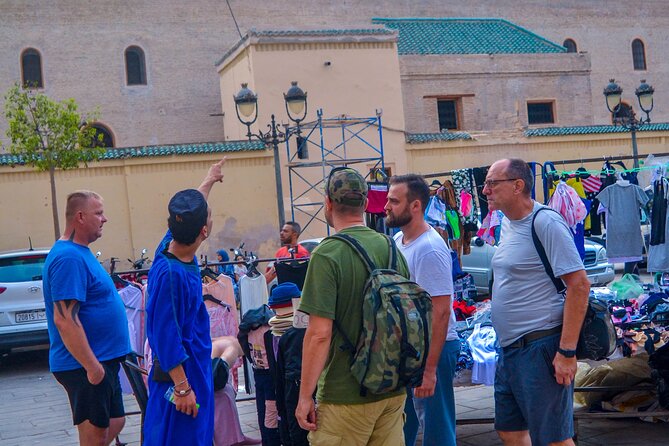
Fez el-Bali can feel confusing at first. Its pedestrian lanes twist through markets, religious buildings, workshops, food stalls, and residential corners. There are few wide streets to use as reference points, and the old city is best understood on foot.
A local guide can give the route meaning. Instead of seeing a decorated doorway as just another pretty entrance, you can learn how the building fits into Fez’s religious, educational, and commercial life. Rachid’s stated aim is to show less obvious corners and introduce you to artisans who continue traditional work.
That matters in Fez. The medina is not simply a preserved old quarter arranged for sightseeing. It is also a working part of the city, with shops, workshops, religious institutions, and homes packed into a historic setting. A good guide helps you look without treating the neighborhood like a stage set.
The tour is advertised as easy and suitable for most people. Still, you should expect continuous walking through narrow streets, market areas, and uneven passages. There is no vehicle transfer between stops, so comfortable shoes matter more than formal dress or expensive gear.
A few more Fez runs to hold up against each other
- Chefchaouen Day Trip from Fez (Shared Group Tour)
★ 4.6 · 2,394 reviews - Fes: Volubilis Roman Ruins, Mouly Idriss, & Meknes Day Trip
★ 4.6 · 2,375 reviews - Fez Medina Guided Tour
★ 4.6 · 2,079 reviews
Kairaouine Mosque and the center of learning
The first stop is Kairaouine Mosque, also known as Al-Qarawiyyin. Its construction was completed in 859 AD under Fatima bint Muhammad al-Fihri, and it grew through later expansions by different rulers, including the Zenati princes and the Almoravids.
The mosque has 17 doors and two wings. Its importance reaches beyond prayer. It has long been tied to religious study and the intellectual life of Fez, which is why seeing it early in the walk gives you useful context for the rest of the medina.
You have about 10 minutes here. That is enough for a guide to explain the building’s role and point out key details, but not enough for a patient architectural study. Admission is included, according to the tour details, though access inside religious sites can depend on local rules and visitor status.
Pay attention to the surrounding lanes. The mosque sits near some of the city’s most active markets, and the connection between worship, study, trade, and neighborhood life becomes clear as you continue.
Sidi Ahmed Al-Tijani Zawiya
The next short stop is the Zawiya of Sidi Ahmed al-Tijani, also called Zawiya Tijaniya Al Kobra. A zawiya is a religious complex connected with teaching, remembrance, and the work of a spiritual order.
This one is dedicated to Sheikh Ahmad al-Tijani, founder of the Tijaniyyah tariqa in the 18th century. He is buried at the site. The building is in the Al-Blida area of Fes el-Bali, close to the University of Al Quaraouiyine.
The exterior is easy to identify. Look for its highly decorated street-facing facade and turquoise minaret. You get roughly 10 minutes, so Rachid’s explanation will be more useful than trying to inspect every detail on your own.
This stop may appeal most to visitors interested in Morocco’s religious traditions. If your main interest is food, shopping, or architecture, it may feel brief, but it gives the walk a stronger sense of place.
The Royal Palace gates in Fez
The Royal Palace, or Dar el-Makhzen, dates in its current form to the 1960s. It is known for colorful tilework, landscaped gardens, and large golden doors decorated with handcrafted copper details.
You cannot enter the palace grounds. The tour takes you to one of the seven impressive gates, where you can see the tile patterns and carved wood from outside. This is an important expectation to set before booking: the stop is for viewing and photographs, not a palace interior visit.
The 10-minute pause works well for the gate itself. It would not be enough for a full palace tour, but no such access is promised. I see this as a useful photo stop rather than a major historical visit.
Same city gate, a very different afternoon:
- Blue City magic: Affordable Day Trip from Fez to Chefchaouen
★ 4.6 · 1,960 reviews - From Fez: Sahara Desert 2-Day Tour with Merzouga Camp Stay
★ 4.8 · 1,716 reviews - Fes: Museum, Al Attarine Madrasa & Tannery and Medina Tour
★ 4.6 · 1,655 reviews - From Fez: Chefchaouen Day Trip with Hotel Pickup
★ 4.6 · 1,534 reviews
Al-Attarine Madrasa and Marinid design
Al-Attarine Madrasa is one of the most rewarding architectural stops on the route. Built between 1323 and 1325 by Marinid sultan Uthman II Abu Said, it takes its name from the nearby Souk al-Attarine, the market associated with spices and perfumes.
The madrasa is admired for the way it uses a small site efficiently. Its decoration combines carved plaster, wood, tilework, and geometric design in a carefully arranged space. The building is often described as one of the finest examples of Marinid architecture in Fez.
You have about 15 minutes here, the longest dedicated time for a single monument apart from the general walk through Fes el-Bali. Admission is not included at this stop, so allow for a separate entrance charge. The exact fee is not provided, so check locally before entering.
The itinerary later lists Al-Attarine again, this time describing the market. That appears to refer to the adjoining Souk Attarine rather than a second madrasa visit. The combination makes sense: first see the school, then understand the commercial district that gave it its name.
Bab Boujloud, Fez’s blue gateway
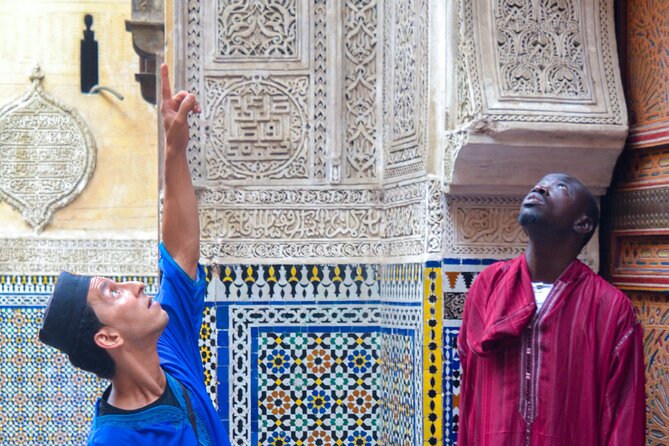
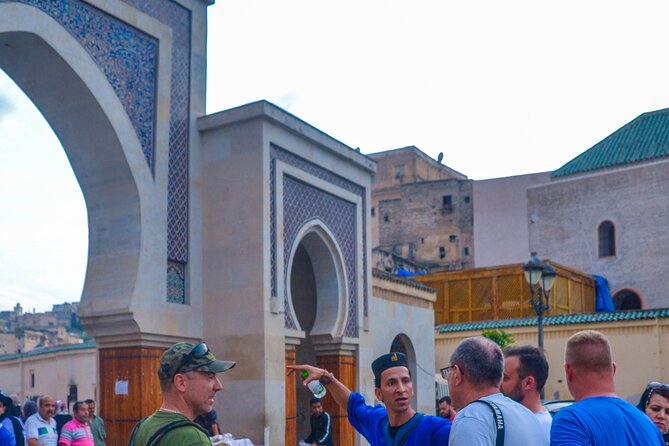
Bab Boujloud is one of the best-known gates in the old city wall. It sits on the northwestern side of Fez near Al-Basha Al-Baghdadi Square and is often treated as the main entrance to the medina.
The gate is a useful orientation point. From here, the old city opens into a maze of lanes, and the nearby Bou Inania Madrasa helps establish the architectural character of the area. The tour gives this stop about 10 minutes.
You will likely find the gate more useful as a starting marker than as a place to spend a long time. Take in the tilework, note the flow of people entering and leaving, and then follow Rachid into the older quarter.
One hour inside Fes el-Bali
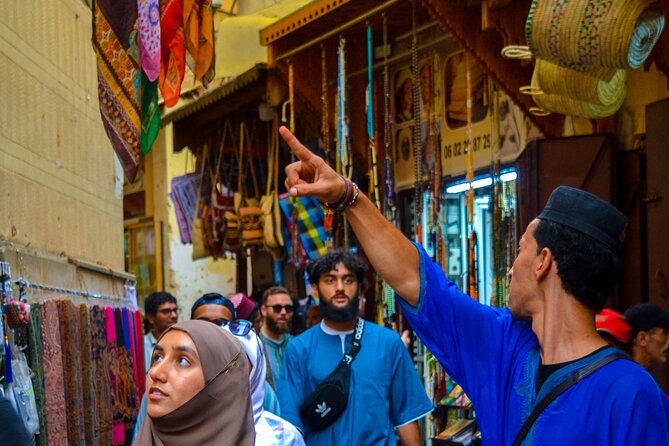
The biggest portion of the tour is a one-hour walk through Fes el-Bali. This is where the experience either earns its price or feels rushed, depending on how much explanation Rachid provides and how smoothly the group moves.
Fes el-Bali is described as one of the largest old cities in the world that still retains its original form. Its lanes divide into different areas on either side of a winding river. The north bank contains many historic monuments and markets, while the south bank has narrower passages used more by local residents.
This section gives you the best chance to see daily life rather than only famous facades. You may pass food sellers, craft workshops, spice shops, copper goods, carpets, musical instruments, and ordinary residential streets. The tour promises visits to local artisans and opportunities to sample local cuisine, although the supplied details do not specify exactly what food is included or how many tastings you receive.
Ask Rachid direct questions here. You can ask how the market is organized, which crafts are made locally, and how the old city functions for residents. A two-hour tour cannot explain everything, but a good conversation can help you decide where to return later on your own.
Souk Attarine and Fez’s traditional trades
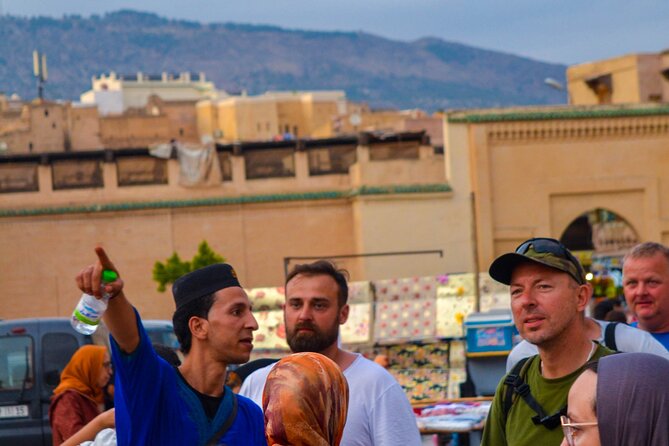
Souk Attarine lies near Kairaouine Mosque and is associated with perfumes, herbs, medicinal plants, and traditional remedies. It is one of the old city’s busiest commercial areas, with shops packed into a narrow market street.
The name links back to the madrasa. This is one of the nice details of the route: the tour connects architecture with commerce rather than treating each stop as an isolated attraction.
The market has two large doors that close in the evening. You have about 10 minutes here, which is enough to notice the smells, colors, and tightly arranged shops. If you want to buy something, be aware that shopping can quickly consume the rest of your tour time.
I would treat this stop as a place to observe first and purchase later. You can compare goods and prices more calmly after the guided walk, when you are not trying to keep up with a group.
Dar Batha Museum and royal collections
Dar Batha began as a summer residence prepared for royal receptions. Sultan Moulay Abdel Aziz completed the palace in 1897, and it became a regional museum of arts and customs in 1915.
The museum’s collection includes manuscripts, astrolabes, copperwork, wood, plaster, marble, coins, jewelry, clothing, textiles, and ceramics. A brick room receives special attention in the description.
The scheduled visit is only about 10 minutes. That is enough for an introduction or a quick look at the exterior and key features, but not enough to study a collection of roughly 6,000 objects. If the museum is a major reason you want to visit, you should plan a separate, longer visit rather than relying on this tour stop.
Still, Dar Batha adds a different note to the route. After markets and religious buildings, it shows how art, royal life, and material culture are presented in a former palace setting.
Chouara Tannery and the smell of leather
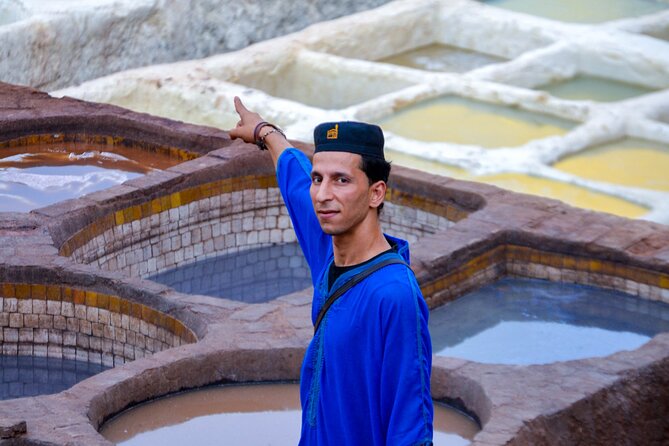
The Chouara Tannery is likely to be the tour’s most striking stop. Fez is known for leather goods, and the tannery is one of the oldest and largest of the city’s traditional leather-working sites.
From the surrounding area, you can see the old method of treating hides in large vats. The work is practical, physical, and not polished for tourism. That is part of its appeal, but the smell can be strong. Prepare for an intense sensory experience rather than a quiet museum visit.
The stop lasts about 15 minutes. You may see leather production and shops connected with the trade, though the supplied information does not promise a specific workshop demonstration or purchase. If you are sensitive to odors, keep that in mind before booking.
I like that this stop connects a famous product to the labor behind it. Fez leather goods are easier to appreciate when you understand that the craft depends on old techniques and skilled workers, not just attractive finished bags and slippers.
Moulay Idriss II Mausoleum from outside
The final listed stop is the Zaouia of Moulay Idriss II, a major religious monument in the old city. Moulay Idriss II is an important figure in Fez’s story, and the mausoleum is a place of religious significance.
Foreign tourists cannot enter the mausoleum. You can view the entrance and take photographs from outside. Moroccan visitors may cross the threshold and see the tomb, which is surrounded by a wooden frame and covered with a red cloth bearing Quranic verses.
This distinction is important. The stop is not an interior tour, and you should not expect to see the tomb up close. Ten minutes is enough for an exterior explanation and photographs.
For me, the value here comes from learning about local religious practice and visitor boundaries. Respectful observation matters more than trying to get a better photograph.
Is $29.08 a fair price?
At $29.08 per person, the tour sits in a sensible range for a short private-style walking experience, particularly with a maximum of 10 people. You are paying for local orientation, explanations, and help finding your way through a complicated medina, not for transportation or an all-day guided program.
The value depends on the guide’s delivery. Ten stops in two hours means most visits last only 10 to 15 minutes, with one hour devoted to the old city walk. That is useful for a first look, but it is not a substitute for visiting the madrasa, museum, or tannery at length.
Admission to Al-Attarine Madrasa is not included. The details say admission is included at several other stops, but access restrictions still apply at the Royal Palace and Moulay Idriss II Mausoleum. Ask before booking which entrance fees, if any, you will pay on the day.
The small group size is a real advantage. With no more than 10 people, you should have a better chance of hearing explanations and staying together in narrow lanes than you would with a large coach group.
A note about reliability and meeting arrangements
Most of the information presents Rachid as friendly, locally connected, and committed to responsible tourism. The stated goal is to support local businesses, traditional crafts, and ethical practices. Those are good priorities, especially in a historic neighborhood where tourism can affect working communities.
There is also a serious warning to consider. One Italian-language complaint alleges that the guide left the party in the medina without directions and described him as operating irregularly. In his response, Rachid apologized, said the situation was outside his control, denied being a fraud, and stated that he refunded the money. He also referred to complications around work taxes and licensing dating back to the 2020 pandemic period.
Because of that mixed record, I would confirm the meeting point, the guide’s name, and a working phone number before setting out. Keep the booking confirmation on your mobile phone. The tour uses a mobile ticket, and confirmation is sent within 48 hours, subject to availability.
Who should choose this Fez walking tour?
I would recommend it to you if you want a short introduction to Fez before exploring alone. It suits first-time visitors who want help with orientation, architecture, markets, and local customs without committing to a full-day program.
It also fits people who care about craft traditions and local businesses. The tannery, perfume market, and artisan visits give the route a practical connection to the city’s working culture.
You may want another option if you prefer long museum visits, a slow photographic walk, or guaranteed access inside every monument. The schedule is tight, and several important places are viewed only from outside.
The walk is described as easy and suitable for most people, but it remains a two-hour walking activity. If you have difficulty walking through narrow or uneven streets, ask the provider for specific route details before booking.
Should you book Rachid’s Fez medina tour?
Book it if you want a compact first look at the old city, a local guide named Rachid, and a route that mixes monuments with markets and traditional trades. The $29.08 price is fair when the guiding is strong, and the 10-person limit keeps the experience manageable.
I would not book it expecting a full museum tour or private access to religious sites. Confirm the meeting arrangements in advance, budget separately for Al-Attarine Madrasa, and remember that the itinerary moves quickly.
For many people, this works best on the first day in Fez. Use it to get your bearings fast, note the places you want to revisit, and then return later for a slower look at the madrasa, museum, souks, or leather shops.
FAQ
Where does this walking tour take place?
The tour takes place in Fez, Morocco, mainly through Fes el-Bali, the old city or medina.
How long does the tour last?
The tour lasts approximately two hours.
Who guides the experience?
The tour is led by Rachid, a local guide.
How many people can join the tour?
The group has a maximum of 10 participants.
Is transportation included?
No. The experience is a walking tour only, with no transportation between stops.
Is the tour suitable for most people?
The tour is described as easy and suitable for most people. It involves walking through the old city.
Can foreign visitors enter the Royal Palace?
No. Foreign tourists cannot explore the Royal Palace grounds. The tour views the palace from one of its decorated gates.
Can foreign visitors enter the Moulay Idriss II Mausoleum?
No. Foreign tourists are not allowed inside the mausoleum and can view it from outside.
Is admission to Al-Attarine Madrasa included?
No. Admission to Al-Attarine Madrasa is listed as not included.
What is the cancellation policy?
You can cancel at least 24 hours before the start time for a full refund. Cancellations or changes made within 24 hours are not refunded or accepted.
Just listed around Fez
- Discover the city of Fes on foot with the best guides★ 5.0 · 27 reviews
- VIP TOUR OF FES- Medina by local guide & Rempart by car-FULL Day★ 5.0 · 74 reviews
- day trip from fez to middle atlas mountain★ 5.0 · 17 reviews
- fes medina guided tour★ 4.5 · 60 reviews
- Fes to Volubilis, Moulay Idriss and Meknes Private Day Trip★ 5.0 · 92 reviews
- Fes to Volubilis, Moulay Idriss and Meknes Private Day Trip★ 4.5 · 26 reviews
- Private Fes Medina Walking Tour★ 5.0 · 25 reviews
- Day Trip to Chefchaouen the blue city★ 4.0 · 187 reviews
City Tours, compared.
Blue City magic: Affordable Day Trip from Fez to Chefchaouen
Read our review →
Marrakech Historical and Cultural Tour – Half Day City Tour
Read our review →
Highlights of Marrakech: Private Half-Day City Tour
Read our review →Browse the lists this tour appears in