
Reviewed · COOKING CLASSES
Shared 4 Hours Cooking Class in Marrakesh
Moroccan food tastes better when you help make it. This four-hour Marrakech class takes you into a real Moroccan family home, where Zohra and her daughter Fatim Zahra teach bread, mint tea, salads, and tagine in a relaxed setting. I like the hands-on cooking and the chance to share a meal with a local family. I also like the choice of chicken, lamb, beef, fish, or vegetables for the main dish. The main consideration is that this is a shared class, with up to 10 people, so it will not feel like a private lesson.
At $81.30 per person, the price is fair if you value a meal, transport in an air-conditioned vehicle, and personal cultural contact in one package. I especially appreciate the family teaching style described by past participants, with Zohra leading the cooking and Fatim Zahra helping with translation and conversation. You should allow about four hours and confirm the pickup details before setting out.
In This Review
- Key points at a glance
- Entering a Moroccan home instead of a cooking studio
- Making Moroccan bread by hand
- The mint tea ritual and Moroccan hospitality
- Three salads that show Morocco’s range
- Choosing between tagine, couscous, and several proteins
- Lunch is part of the lesson, not an afterthought
- How the four-hour schedule works
- What the $81.30 price really buys
- Who will enjoy this class most
- Booking tips and cancellation
- Should you book the Marrakech family cooking class?
- FAQ
- How long does the cooking class last?
- Where does the class begin and end?
- Is pickup available?
- What food will I learn to prepare?
- What choices are available for the main dish?
- What languages are supported?
- How many people can join the class?
- Can I cancel for a full refund?
Key points at a glance
- Cook in a Moroccan family home: The setting gives you a closer look at everyday hospitality than a restaurant kitchen can provide.
- Make a full meal: You prepare bread, mint tea, several salads, and a tagine or couscous dish.
- Choose your main course: Options include chicken, lamb, beef, fish, or vegetables, depending on the class arrangements.
- Learn from Zohra and Fatim Zahra: Their warm mother-and-daughter teaching team is one of the experience’s strongest features.
- Small shared group: The maximum is 10 people, which keeps the class personal without making it private.
- Simple logistics: Pickup is offered, the activity ends back at the meeting point, and free cancellation is available up to 24 hours ahead.
Entering a Moroccan home instead of a cooking studio
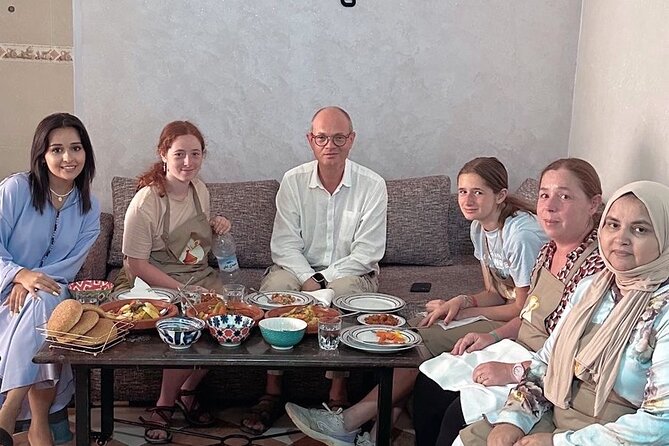
The setting is the heart of this class. You are welcomed into the home of a Moroccan mother rather than placed in a polished school designed mainly for visitors. That difference matters.
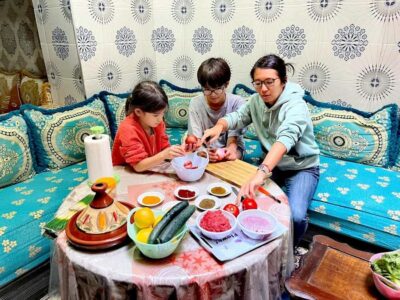
A cooking studio can teach technique well, but a family home gives the meal a social purpose. Moroccan cooking is closely tied to hospitality, and here you get to see that hospitality in practice. You are not just learning how to season a tagine. You are sharing a table, hearing family stories, and taking part in a household tradition.
Zohra leads the cooking, while Fatim Zahra often helps explain the steps and keep the conversation moving. That mother-and-daughter partnership is useful for English-speaking participants because the guide service is offered in English and French. The result should feel more like cooking with a welcoming relative than following a formal restaurant demonstration.
The home setting can also mean less polish than a commercial school. The kitchen may be compact, the pace may depend on the household, and the class may feel informal. If you want chef-style precision, printed recipes, and a carefully staged presentation, this may not be the right fit. If you want warmth and contact with local life, the informality is part of the appeal.
More Cooking Classes in Marrakech
- Marrakech: Moroccan Cooking Class with Pickup
★ 4.6 · 1,862 reviews - Marrakech: Traditional Moroccan Cooking Class & Market Visit
★ 4.8 · 1,861 reviews - Marrakesh: Moroccan Dishes Cooking Class with a Local Chef
★ 5.0 · 1,615 reviews
Making Moroccan bread by hand
Bread is one of the best opening lessons because it gives you an immediate, physical task. You learn to mix and knead traditional Moroccan bread, then prepare it for baking. One particularly memorable detail is the use of a clay oven, which adds a strong sense of place to an otherwise familiar kitchen activity.
Moroccan bread is not just a side item. It is used throughout the meal, including for scooping up salads and sauce. Learning to make it helps you understand how the meal is meant to be eaten, not simply how it looks on a plate.
You should expect to work with your hands. That makes this more useful than watching someone shape dough while you stand nearby. You can feel the texture change as the dough comes together and see how a simple mixture becomes a daily staple.
The bread lesson also sets the tone for the class. This is not a rushed tasting with a few token tasks. You take part in several stages of the meal, and the final lunch reflects work you helped do. I find that especially worthwhile for anyone who likes to return home with a skill rather than only a photograph.
The mint tea ritual and Moroccan hospitality
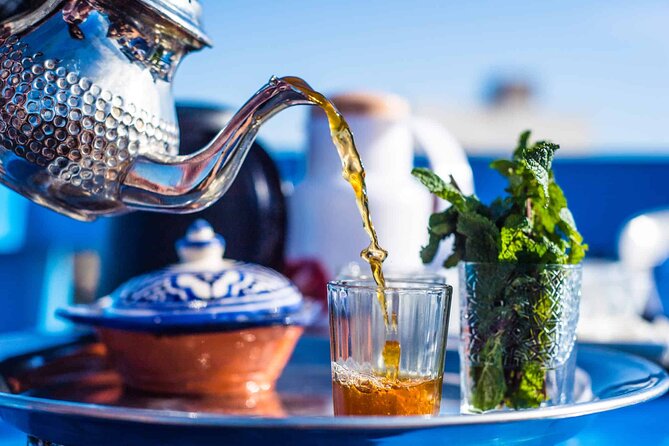
Mint tea is both a drink and a social custom. The class includes instruction in preparing it, giving you a chance to understand why it matters in Moroccan homes.
The ritual helps explain the welcoming atmosphere from the moment you arrive. Tea is traditionally offered as a sign of hospitality, so learning to prepare it gives you a small window into how social life works around food and drink. It also makes a pleasant pause between the cooking tasks.
Do not expect this part to be a long formal lecture. The information provided describes a practical lesson focused on the secrets of preparing Moroccan mint tea and its place in hospitality. You will likely learn through demonstration and participation, then drink the tea as the meal comes together.
For me, this is exactly the sort of detail that can get lost on a standard sightseeing day. You may eat mint tea several times in Marrakech, but making it with a local family gives the custom more meaning. It turns a familiar beverage into part of the day’s story.
Three salads that show Morocco’s range
Before the main dish, you prepare a selection of salads. The planned choices include zaalouk, taktouka, and Moroccan tomato salad. These dishes are not filler. Together, they show how Moroccan cooks build flavor from vegetables, herbs, spices, and careful preparation.
Zaalouk is a smoky eggplant salad. Its soft texture and cooked flavor make it very different from a raw green salad. Taktouka combines peppers and tomatoes for a sharper, more savory dish. The tomato salad provides a fresher contrast.
Preparing all three gives you a useful lesson in balance. A Moroccan meal is not built around one heavy dish alone. Several small preparations appear around the table, each with a different texture and flavor. You can then taste how they work with the bread and the sauce from the tagine.
The class also gives you a chance to ask about family methods. The recipes are described as being passed down through generations, so you may learn small habits that a standard cookbook leaves out. The exact ingredients and quantities can vary, which is worth remembering if you hope to recreate the meal precisely at home.
Same city gate, a very different afternoon:
- Marrakech: Agafay Desert Sunset, Camel Ride, and Dinner Show
★ 4.6 · 35,119 reviews - From Marrakech: Ouzoud Waterfalls Guided Hike and Boat Trip
★ 4.7 · 33,630 reviews - Marrakech: Agafay Desert Quad & Camel Rides with Dinner Show
★ 4.8 · 27,382 reviews - Marrakech: Agafay Desert Quad Biking Tour with Dinner-Show
★ 4.8 · 16,569 reviews
Choosing between tagine, couscous, and several proteins
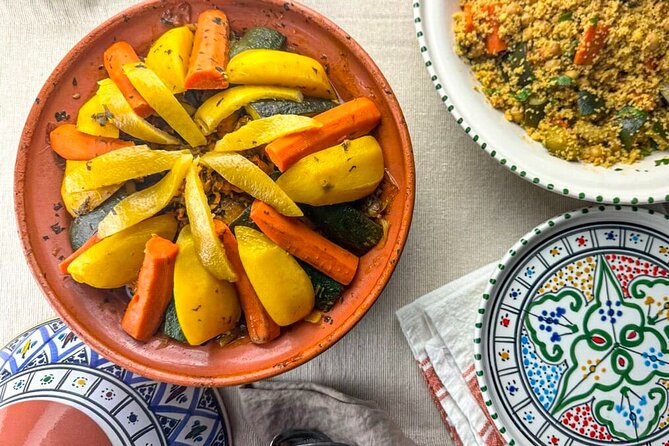
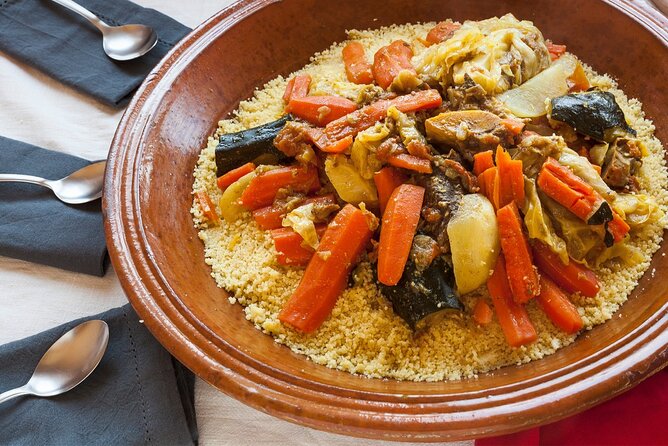
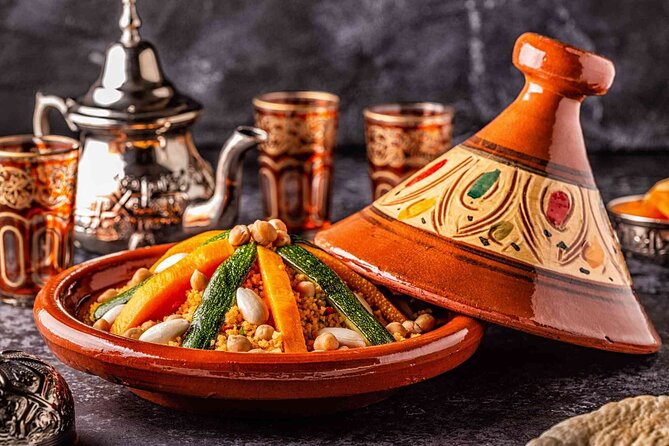
The main cooking project is the tagine or couscous dish. The stated choices include chicken, lamb, beef, fish, and vegetables, although the exact selection may depend on what is arranged for your session. This flexibility is useful for couples and mixed groups with different preferences.
The tagine examples associated with the class show the range of Moroccan cooking:
- Chicken with preserved lemon and green olives
- Lamb with prunes and toasted almonds
- Lamb with apricots and almonds
- Beef with artichokes and peas
- Fish with tomatoes, garlic, and green peppers
- Vegetable tagine with saffron and preserved lemon
- Turkey with cinnamon and dried fruits
These combinations explain why the class is more than a lesson in putting ingredients into a conical pot. You learn how Moroccan cooking handles sweet and savory flavors, preserved ingredients, fruit, spices, and slow cooking.
Preserved lemon and olives give chicken tagine a salty, sharp character. Prunes, apricots, almonds, and cinnamon move lamb toward a sweeter style. Fish with tomatoes and green peppers should feel lighter and more direct, while vegetables with saffron and preserved lemon offer a meat-free option with plenty of flavor.
The class is especially good for someone who has already eaten tagine in Marrakech and wants to understand what happens behind the dish. You will see the preparation, seasoning, and cooking process, then eat the result at the table.
There is one practical limit: the information does not promise that every protein or every recipe will be available at every session. If you have a dietary restriction or a strong preference, ask about it before booking rather than assuming every choice can be accommodated.
Lunch is part of the lesson, not an afterthought
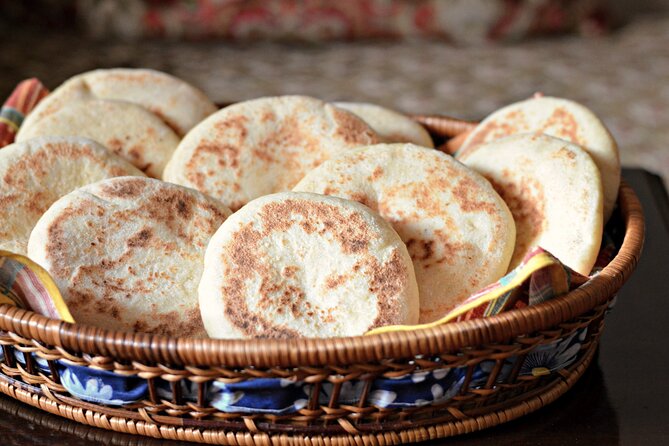
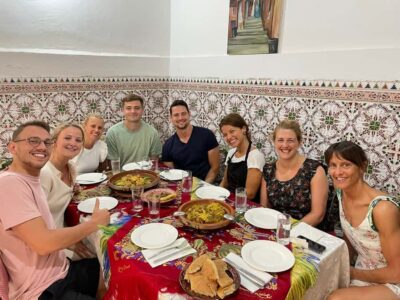
Lunch is included, and it is the natural payoff for the work. You sit down and eat the bread, salads, tea, and main dish in Moroccan style.
That shared meal is a major reason to consider the class. A cooking lesson can be useful, but the meal gives the experience its social finish. You have time to talk, compare the dishes, and enjoy what you made without being hurried out of the kitchen.
The strongest accounts of the class focus on feeling welcomed. Families cook together, tell stories, laugh, and create an atmosphere that feels personal. One account describes the whole family joining in, with children coming to say hello. That kind of contact cannot be guaranteed in every session, but it reflects the family-centered character of the activity.
You should also keep your expectations sensible. This is a four-hour class, not a full day of market visits and cooking. One account describes shopping for ingredients in a local souk, but market shopping is not listed as a guaranteed part of every booking. Treat it as a possible variation, not a promised stop.
How the four-hour schedule works
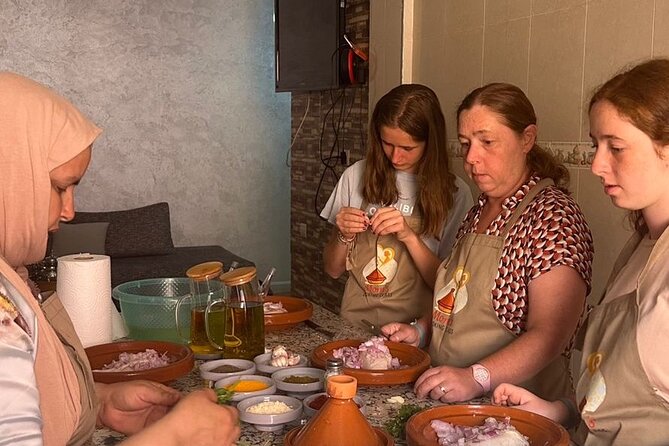
The class lasts about four hours, which gives enough time for several dishes without taking your entire day. The likely rhythm is welcoming tea, bread preparation, salad work, main-dish preparation, cooking time, and lunch.
The tagine itself needs time to cook, and that helps the session feel less frantic. While it develops flavor, you can work on bread and salads or talk with the family. The schedule should feel like a meal being prepared in a home, not a series of unrelated demonstrations.
Pickup is offered, and transport is described as an air-conditioned vehicle. That is helpful in Marrakech, where getting across town can be tiring, especially when you are carrying directions to an unfamiliar residential area. The activity ends back at the meeting point, so you are not left to arrange a separate return after lunch.
The meeting information simply gives Marrakech as the start and end location. For that reason, confirm the exact pickup point and time when you book. The activity is near public transportation, but pickup may be easier than finding the home on your own.
The group limit is 10 people. That is small enough for hands-on work, yet large enough that the class may include several couples or small groups. If you need a quiet, highly tailored lesson, ask about private options before committing. They are not included in the information provided here.
What the $81.30 price really buys
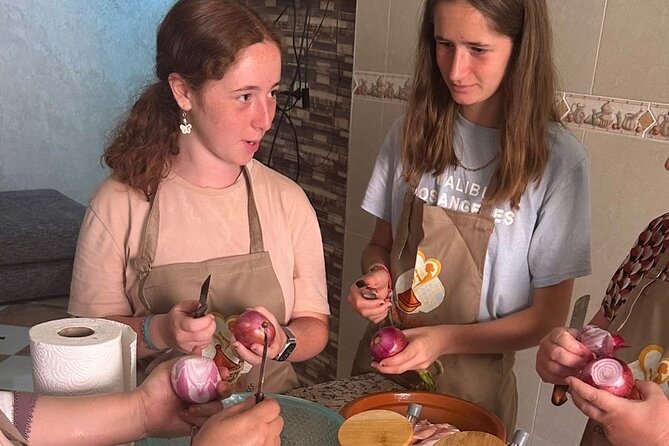
At $81.30 per person, this is not the cheapest way to eat in Marrakech. You can find a restaurant meal for much less. The value comes from combining instruction, ingredients, a full lunch, guide service, transport, and time with a local family.
I would consider the price reasonable for someone who wants a cultural activity as well as food. You are paying for access to a home setting and for the chance to participate in preparation. Those are the parts that a normal restaurant meal cannot offer.
The value is strongest if you enjoy cooking or want a meaningful break from monuments and markets. It is weaker if you mainly want to sample food quickly, avoid group activities, or prefer a professional kitchen with formal instruction.
The small maximum group helps support the price. Ten people is not intimate in the same way as a private class, but it is far more manageable than a large coach group. You should have a fair chance to take part, ask questions, and follow the cooking.
The 5 out of 5 rating across 49 ratings, along with a 100 percent recommendation rate, suggests that the central promise is being delivered consistently. The praise centers on kindness, family contact, hands-on cooking, and the quality of the meal. Those are the points I would use to judge the experience, rather than expecting luxury transport or a polished culinary school.
Who will enjoy this class most
You are a good match for this activity if you:
- Like learning by doing
- Want contact with Moroccan family life
- Enjoy trying several dishes in one meal
- Appreciate warm, informal hosting
- Have about four hours free in your Marrakech schedule
- Want to learn recipes you can attempt at home
- Prefer a small shared group to a large organized tour
Families, couples, solo participants, and small groups can all fit the format. The choice of main dish also makes it easier for a mixed group to find something appealing.
I would be more cautious if you dislike working in a shared kitchen, need a fully private setting, or want detailed guarantees about the exact menu. The class is personal, but it is still a shared activity, and the food choices can vary.
It is also worth thinking about language. English and French guide service are included, which should help most international participants, but the experience remains a family exchange rather than a formal lecture. You may enjoy it most if you are comfortable with conversation, gestures, and an easygoing pace.
Booking tips and cancellation
The activity is often booked about 19 days ahead, so I would not leave it until the final day of a short Marrakech visit. Confirmation is received at booking, and a mobile ticket is offered, which keeps the practical side simple.
Tips are not included. Bring this cost into your planning and offer a tip if you feel the family and guide provided good service.
Free cancellation is available if you cancel at least 24 hours before the local start time. Changes or cancellations made inside that 24-hour window are not accepted for a refund. Check the local cut-off time carefully, especially if you are booking around flights or a hotel change.
Should you book the Marrakech family cooking class?
I would book this class if your idea of a good Marrakech day includes food, conversation, and a closer look at daily life. The strongest features are the home setting, the mother-and-daughter teaching team of Zohra and Fatim Zahra, the hands-on bread and salad preparation, and the full tagine meal you help create.
I would skip it if you want a private chef lesson, a fixed menu with guaranteed ingredients, or the lowest-cost lunch in town. For everyone else, the $81.30 fee buys more than recipes. It buys four hours of participation and a welcoming table, which can be one of the more lasting memories of Marrakech.
FAQ
How long does the cooking class last?
The class lasts approximately four hours.
Where does the class begin and end?
It begins in Marrakech, Morocco, and ends back at the meeting point.
Is pickup available?
Yes. Pickup is offered, and transport is provided in an air-conditioned vehicle.
What food will I learn to prepare?
You will learn to make Moroccan bread, mint tea, salads such as zaalouk, taktouka, and tomato salad, plus a tagine or couscous dish.
What choices are available for the main dish?
The available choices include chicken, lamb, beef, fish, or vegetables. The exact selection may depend on the arrangements for your class.
What languages are supported?
An English and French guide is included.
How many people can join the class?
The activity has a maximum of 10 participants.
Can I cancel for a full refund?
Yes. You can cancel for a full refund up to 24 hours before the experience start time. Cancellations or changes made less than 24 hours before the start are not accepted for a refund.
More Workshops in Marrakech
- Moroccan Cooking Class & Marrakech Market Visit with Chef Khmisa
★ 5.0 · 1,504 reviews - Half-Day Cooking Class with Local Chef Laila in Marrakech
★ 5.0 · 952 reviews - Marrakech: Pottery Workshop with Moroccan Tea
★ 4.8 · 756 reviews - Marrakech: Moroccan Cooking Class with a Local Family
★ 4.9 · 668 reviews
Just listed around Marrakech
- Zagora: 2-Day Desert Trip from Marrakech★ 4.4 · 31 reviews
- Traditional spa Hammam & Massage with Hotel Transfers★ 4.0 · 24 reviews
- Day trip to OUZOUD waterfall with guide&boat ride from Marrakech★ 5.0 · 172 reviews
- quad bike tour in the palmeraie of Marrakech★ 4.5 · 43 reviews
- Half day quad desert agafay★ 4.5 · 24 reviews
- walking tour★ 5.0 · 46 reviews
- private tour of Marrakech 4 hours with multilingual driver★ 5.0 · 117 reviews
- 3 days tour from Marrakech to Merzouga desert★ 5.0 · 55 reviews
Cooking Classes, compared.
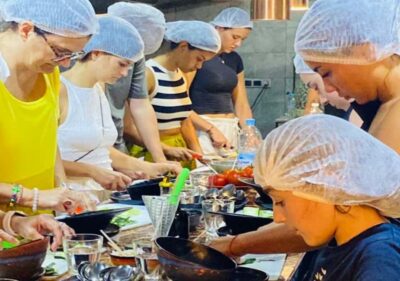
Traditional Moroccan Cooking Class & Market Visit
Read our review →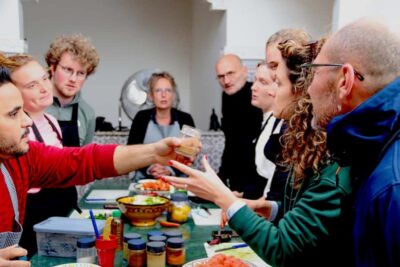
Moroccan Dishes Cooking Class with a Local Chef
Read our review →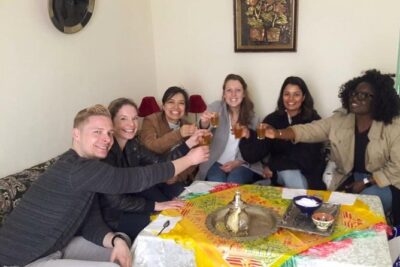
Moroccan Cooking Class & Marrakech Market Visit with Chef Khmisa
Read our review →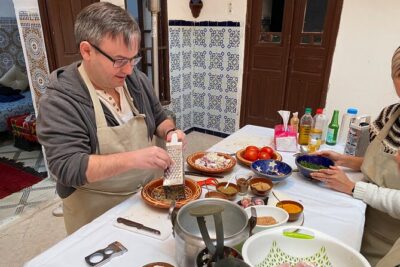
Half-Day Cooking Class with Local Chef Laila in Marrakech
Read our review →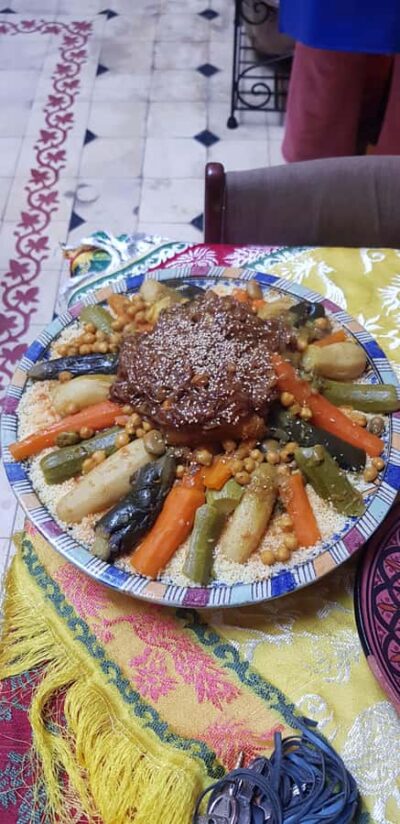
Browse the lists this tour appears in